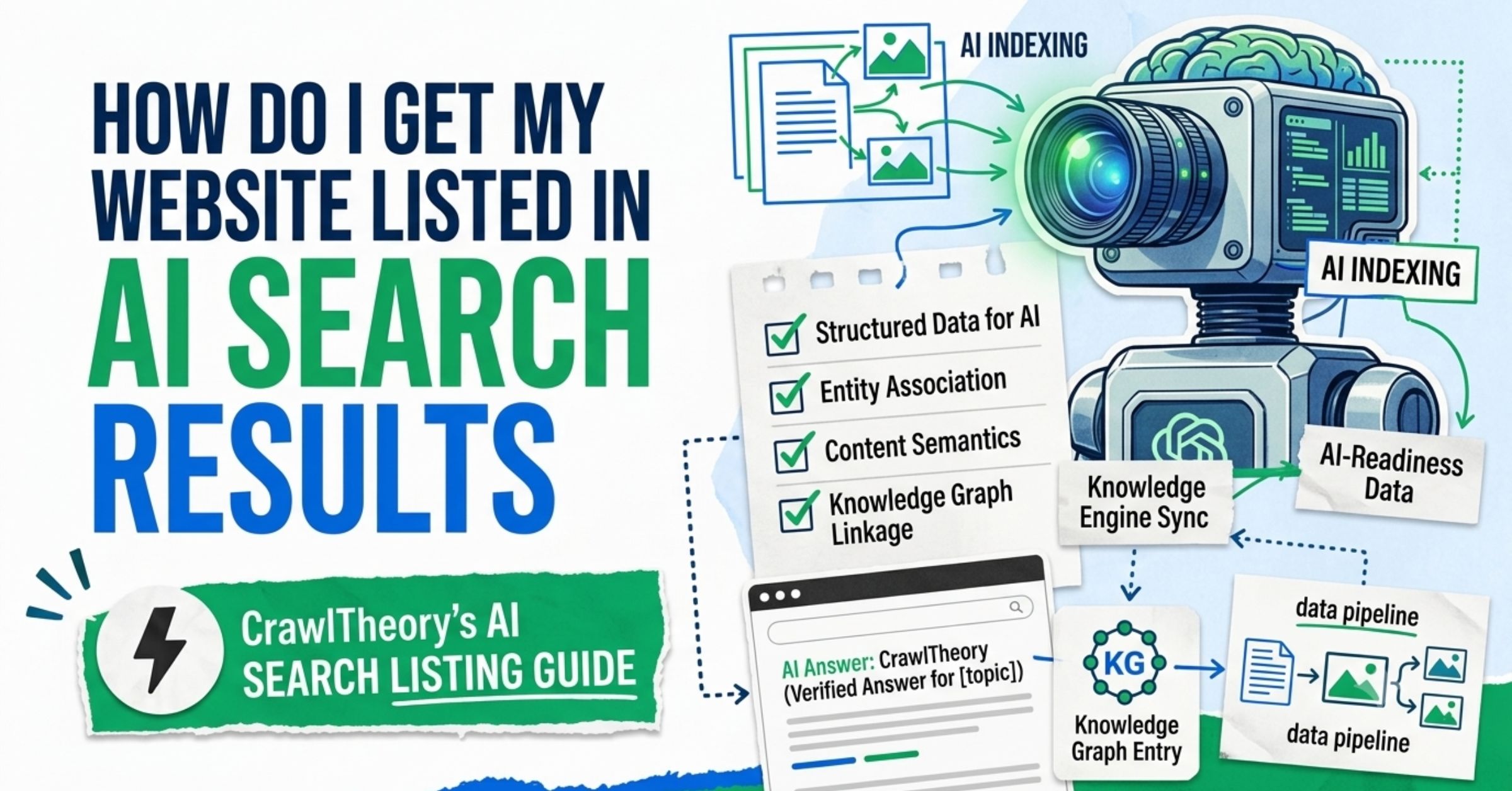
Introduction: A New Kind of Search Is Here
Something shifted in how people look for things online.
A growing number of users do not type a query into Google and scroll through ten blue links anymore. They ask ChatGPT a question. They type into Perplexity. They get an AI-generated answer at the top of Google before they even see any website links.
AI referrals to websites jumped 357% in June 2025 compared to the same month in 2024, reaching 1.13 billion visits in a single month.
The question every business owner and website manager is now asking is simple: How do I make sure my website shows up in these AI answers?
Google AI Overviews now appear on 48% of all Google searches as of March 2026 — up from just 6.5% in early 2025. That's a sevenfold jump in about one year.
This guide answers that question, step by step, in plain language. No jargon. No theory. Practical steps grounded in five years of SEO work across 300+ websites.
What Does 'Listed in AI Search Results' Actually Mean?
What is AI search and how does it work?
AI search refers to any platform that uses artificial intelligence to generate a direct answer to your question, rather than just showing you a list of links. The major players right now are:
- Google AI Overviews — the AI-generated summary that appears at the top of many Google searches
- ChatGPT — OpenAI's conversational AI, which can browse the web and cite sources
- Perplexity — an AI search engine built specifically around citing sources in its answers
- Microsoft Copilot — built into Bing, generates AI answers with citations
- Google Gemini — Google's own standalone AI assistant
When these platforms answer a question, they pull content from websites they trust and either cite them as sources or quote them directly. Getting your website "listed" means being one of those cited sources.
If your website is not indexed by Google or Bing, AI platforms almost certainly cannot find or cite it. Fix basic crawlability before anything else. An uncrawlable website is invisible to both search engines and AI.
Why does this matter for your business?
The traffic numbers from AI search are still small compared to Google's total volume. But the quality of that traffic is exceptional.
LLM traffic has higher conversion rates than organic traffic: ChatGPT converts at 15.9%, Perplexity at 10.5%, Claude at 5%, and Gemini at 3%. Google's organic conversion rate is 1.76%.
People who arrive at your site from an AI recommendation already trust the recommendation. They are warm, high-intent visitors. They are not browsing. They are deciding.
AI referral traffic converts 4.4x to 23x better than regular organic search traffic, according to multiple 2025 studies. Even a small volume of AI-driven visits can deliver outsized business results.
The 8 Steps to Get Your Website Listed in AI Search Results
Step 1: Start With Your SEO Foundation — Not AI Tricks
Do I need special AI optimization, or will regular SEO work?
Regular, well-executed SEO is the foundation of AI search visibility. This is not a shortcut or a workaround — it is simply how it works.
77% of AI optimization comes from a strong traditional SEO foundation. Sites ranking in Google's top 10 are significantly more likely to be cited by AI models.
AI platforms pull from sources they already consider authoritative. If your website does not rank on Google, it is largely invisible to AI search, too. The checklist is the same:
- Your site is indexed and crawlable
- Pages load quickly on mobile and desktop
- Your content is original and actually useful
- You have earned quality backlinks from credible sites
For a local business, getting to 40–60 quality backlinks and ranking in the top 5 positions for your core keywords dramatically increases your chances of being cited by AI tools. I have seen this consistently across hundreds of client sites. The SEO work you do for Google also does the work for AI — they are not separate channels.
Not immediately. AI platforms weight authority, and authority takes time to build. A new site can realistically appear in AI results within 6–12 months with consistent, high-quality content and backlink growth.
No. Google pulls from a wider set of pages it considers relevant and authoritative for the query — not strictly the top 3 organic results. A well-structured page that directly answers a specific question can be cited even if it ranks on page two for a broader keyword.
Step 2: Write Content That Answers Specific Questions Directly
What kind of content does AI prefer to cite?
AI systems break your content into smaller, digestible "chunks" or passages, pulling relevant sections to craft answers. This approach means AI thrives on well-structured content where each segment can stand on its own.
The implication is practical: write content that answers one specific question per section. Not vague overviews. Not long preambles. The answer is stated clearly, within the first two or three sentences of each section.
Here is the content structure that AI platforms consistently cite:
- FAQ-format pages where each question is a heading and the answer immediately follows
- How-to guides with numbered steps
- Definition-led sections that open with a plain-language answer before expanding
- Comparison content that gives clear verdicts ("X is better than Y when...")
- Statistics and data that AI can quote as evidence
Long-tail, question-based keywords that mimic how real people talk and search make your content more likely to appear in AI summaries. AI-driven tools often surface content based on natural, conversational queries.
Neither length alone matters. What matters is whether each section directly answers the question it is supposed to answer. A 500-word page with a clear, complete answer to one question will be cited more than a 3,000-word page that meanders around the same topic.
Blog posts and FAQ pages are most frequently cited by AI platforms. Service pages can also appear, but they need to contain genuinely useful content — not just a sales pitch. A service page that explains how a service works, who it helps, and what results to expect is far more likely to be cited than one that just lists features.
Step 3: Add Schema Markup (Structured Data) to Your Pages
What is schema markup, and why does it help with AI search?
Schema markup is code you add to your website that labels your content for machines. It tells search engines and AI systems: "This section is a question and answer. This is a review. This is a local business at this address."
In April 2025, the Google Search team confirmed that structured data gives an advantage in search results. Microsoft Bing's principal product manager also confirmed in March 2025 that schema markup helps Microsoft's LLMs understand content for Copilot.
Pages with valid structured data — particularly FAQ, HowTo, and QAPage schema — appear 20 to 30% more often in AI-generated summaries than unstructured pages, according to 2025 benchmarks from Semrush and Measured.com.
The most important schema types for AI visibility are:
| Schema Type | What It Does |
|---|---|
| FAQPage | Marks up question-and-answer content so AI can extract individual Q&As |
| Article | Labels blog posts and guides with author, publish date, and topic |
| Organization | Tells AI your business name, location, website, and what you do |
| LocalBusiness | For businesses serving a geographic area — includes NAP (name, address, phone) |
| HowTo | Marks up step-by-step instructions |
| BreadcrumbList | Helps AI understand your site structure |
Use JSON-LD format. Every major AI engine prefers JSON-LD because it is cleanly separated from your HTML and easier to parse programmatically. Google's official guidance explicitly recommends JSON-LD for AI-optimized content.
One important caveat: schema is not a magic switch. LLM systems appear to prioritize relevance, topical authority, and semantic clarity over whether content has structured markup. Schema helps AI read your content faster. It does not replace the need for content that is actually useful.
Stale or inaccurate schema markup can actively hurt your AI visibility. If your structured data says one thing and your page content says another, AI systems may stop citing you entirely — across all pages, not just the one with the error.
Use Google's free Rich Results Test at search.google.com/test/rich-results. Paste your URL, and it will show you any errors in your schema. Fix errors before worrying about adding new schema types.
Not directly. Schema helps Google understand your content better, which can improve how your content appears in search results and how often it is cited in AI answers. It is a supporting signal, not a ranking factor.
Step 4: Build Topical Authority With a Content Cluster
What is topical authority, and why do AI platforms care about it?
Topical authority means your website is recognized as a trusted, comprehensive source on a specific subject. Not a generalist who mentions the topic occasionally — a specialist who covers it deeply and consistently.
Building topical authority by creating a hub of content around a core subject is a powerful strategy for proving your expertise to AI. This means creating a cluster of interlinked content around a central theme.
In practice, this means:
- Choose 3–5 core topics your business is the expert on
- Write a comprehensive "pillar" page for each topic
- Create supporting posts that go deep on subtopics, all linking back to the pillar
- Interlink related posts to each other so the cluster is tightly connected
A real example: I worked with a Jeep modification shop in Roswell, Georgia. Over 12 months, they published consistent, specific content around Jeep builds, off-road modifications, and regional trail guides. By month 12, ChatGPT was citing them when users asked about Jeep modifications in their area. A customer came in specifically because ChatGPT recommended the shop. That is topical authority working as AI visibility.
There is no fixed number. What matters is depth and consistency. Ten tightly focused, well-written posts on one topic will outperform 50 thin, generic posts scattered across unrelated subjects.
No. Your service pages, case studies, FAQs, and even your about page all contribute to topical signals. Every page that demonstrates knowledge on your core topics adds to your authority.
Step 5: Get Your Business Mentioned on Third-Party Platforms
Which external platforms help with AI search visibility?
AI systems do not only read your website. They read the entire web. Your presence on trusted third-party platforms serves as corroboration — it tells AI: "This business is real, established, and referenced by others."
The platforms that matter most:
- Google Business Profile — cited directly by Google AI Overviews for local queries
- Yelp, Trustpilot, G2, Clutch — review and directory sites AI regularly pulls from
- LinkedIn (company page and personal profiles of your team)
- Industry directories and association listings
- Press mentions and news articles referencing your business
NAP consistency matters here. AI platforms like ChatGPT and Perplexity use NAP (name, address, phone) consistency as a signal when evaluating local business authority. Your business name, address, and phone number should be identical across every platform.
Do not keyword-stuff your content trying to "trick" AI systems. Generative AI tools (ChatGPT, Perplexity, Gemini) pull from sources they trust. Keyword manipulation signals low quality, not authority. Write for humans first.
You do not need to post daily, but having complete, accurate profiles on LinkedIn and other relevant platforms helps. AI systems use social presence as an authority signal. A business with no LinkedIn presence looks newer and less established to AI than one with a complete, active profile.
There is no specific number, but more high-quality mentions on credible sites mean more chances for AI to find and trust you. Think of every legitimate mention as a vote of confidence. Quality matters more than quantity.
Step 6: Make Sure Google Can Crawl and Index Your Site
Why does crawlability matter for AI search visibility?
Google's AI Overviews pull from websites that appear on the results page. If a website is used as a source, the AIO will also link to it. But AIOs only pull from sources that Google considers to be of high authority.
Before your content can be cited, it must be found. A surprising number of websites have technical issues that prevent this:
- Pages blocked by `robots.txt.`
- Content locked behind logins or paywalls
- Slow load times on mobile
- Broken internal links create dead ends
- No XML sitemap submitted to Google Search Console
Check Google Search Console under "Coverage" to see which pages are indexed and which have errors. Submit your sitemap if you have not already. Fix any crawl errors immediately — they are the easiest wins in technical SEO.
Indirectly, yes. Slow pages are less likely to rank well in traditional search, and lower rankings mean less chance of AI citation. More directly, when AI tools browse your site in real time to answer a query, a fast-loading page is read more reliably than a slow one.
Blocking the wrong pages in robots.txt. Many websites accidentally block their most important pages, preventing both search engines and AI crawlers from ever reading them. Check your robots.txt file at yourdomain.com/robots.txt.
Step 7: Establish Author Credibility and E-E-A-T Signals
What is E-E-A-T, and how does it affect AI search citations?
E-E-A-T stands for Experience, Expertise, Authoritativeness, and Trustworthiness. It is Google's framework for evaluating content quality — and it directly influences which content AI Overviews pull from.
In practice, E-E-A-T signals include:
- Author bylines with credentials on every article (not "Admin" or "Staff")
- Author bio pages that clearly explain the writer's relevant experience
- Case studies and real examples that demonstrate lived, hands-on expertise
- Accurate, up-to-date information with publish and updated dates visible
- Clear contact information and about page, establishing who runs the site
- External citations and links to authoritative sources within your content
The businesses that win in AI search are those who create helpful, people-first content that demonstrates true Experience, Expertise, Authoritativeness, and Trust.
Not necessarily. But having a named, credentialed author attached to your content significantly improves trust signals. A law firm article written by "Jane Smith, licensed attorney in California," carries more E-E-A-T than the same article with no author credit.
A Wikipedia page is a very strong authority signal, but it is not required. Focus on getting consistent, positive mentions in credible publications. That has the same effect at scale.
Step 8: Optimize for the Specific Way Each AI Platform Works
Do ChatGPT, Perplexity, and Google AI Overviews work differently?
Yes, and understanding the differences helps you prioritize.
Google AI Overviews prioritize sites already ranking well in Google search. They strongly favor content with clear schema markup, especially FAQPage and HowTo. They appear most frequently on informational queries ("how to," "what is," "best way to").
Perplexity is built to cite sources with every answer. It crawls the web in real time for each query. It consistently references forums, review platforms, and sites with clear, direct answers. Getting cited in Perplexity is strongly correlated with having structured, question-answering content.
ChatGPT uses a combination of its training data and web browsing. ChatGPT accounted for 89.1% of all AI referrals as recently as mid-2025, though by early 2026 its share had dropped to 62.6% as Claude, Gemini, and Perplexity each grew significantly. Getting into ChatGPT's training data requires long-term authority building — being mentioned repeatedly on credible sites over time.
Microsoft Copilot is tightly integrated with Bing search rankings. If you rank well on Bing, you are likely to appear in Copilot answers.
Claude (Anthropic) uses both training data and web browsing in a similar way to ChatGPT. Claude's share of B2B AI referrals grew from 1.4% to 18.5% between mid-2025 and early 2026 — the fastest relative growth of any AI platform in that period.
Optimize broadly. The same practices — strong content, clear structure, schema markup, topical authority, quality backlinks — work across all platforms. There is no separate strategy required for each one.
Open ChatGPT or Perplexity and search for your core service + location. Also try broader questions in your niche. If your site appears as a source, note how your content is being summarized. If it does not appear, the steps in this guide are your starting point.
The llms.txt File: Useful, or Overhyped?
Should I add an llms.txt file to my website?
An llms.txt file is a plain-text file that tells AI systems what your site is about and which pages are most important — similar in concept to robots.txt, but designed for AI models rather than search crawlers.
The llms.txt file is a new web standard that gives website owners control over how large language models like ChatGPT, Gemini, Claude, and others access and use their website content.
Over 844,000 websites had already implemented llms.txt as of October 2025, including major companies like Anthropic, Cloudflare, and Stripe. Yet not a single major AI platform has officially confirmed that they actually read these files.
My recommendation: add it, but do not prioritize it. It takes under an hour to implement, costs nothing, and may become more valuable as AI crawlers evolve. But it is not a substitute for strong content and technical SEO.
How do I create an llms.txt file?
Create a plain text file named llms.txt in the root of your website (e.g., yourdomain.com/llms.txt). Include a brief description of your site, a list of your most important pages with their URLs, and a short description of each. Tools like Yoast SEO (for WordPress) can generate this automatically.
Will llms.txt hurt my site if I add it incorrectly? No. Unlike robots.txt, a poorly written llms.txt file will not block your site from being crawled. The worst case is that AI tools ignore it.
Do not assume an llms.txt file alone will get you cited. As of 2026, no major AI platform has formally confirmed that they use this file during responses. It is a future-proofing step, not a quick fix. Focus on content and authority first.
How Long Does It Take to Show Up in AI Search Results?
What is a realistic timeline for AI search visibility?
There is no instant result here. Based on experience across hundreds of client sites, here is a rough framework:
| Timeline | What Happens |
|---|---|
| Month 1–2 | Technical fixes, content creation starts, schema added |
| Month 3–4 | Google begins indexing new content, early rankings appear |
| Month 5–6 | Perplexity may start citing specific articles that directly answer questions |
| Month 6–9 | Google AI Overviews begin pulling from well-ranked content |
| Month 9–12+ | ChatGPT and broader AI citation; topical authority solidifying |
The sites that see the fastest AI visibility gains are those that already have a solid SEO foundation and begin adding structured content and schema. Starting from scratch takes longer, but the compounding effect of consistent content is significant.
Test your own website in ChatGPT and Perplexity right now. Search for your main service + city (e.g., "best plumber in Austin") and see if you appear. If you don't, the gaps in this guide are exactly why.
A Real-World Example: What AI Visibility Looks Like in Practice
A cleaning service in Kalamazoo, Michigan, started with zero AI search presence. Over five months, they built roughly 200 quality backlinks per month, optimized their Google Business Profile, added FAQ schema to their key service pages, and published consistent blog content answering the questions their customers actually asked ("how often should I schedule a deep clean," "what does a move-out clean include").
By month five, they had over 70 page-one keywords in Google search — and their content was being cited in Perplexity results for local cleaning queries. ChatGPT was recommending them when users asked for top cleaning services in their area. Organic leads tripled in that same period.
This is not an anomaly. It is what happens when the fundamentals are in place: a crawlable, fast website with relevant, structured content and genuine authority signals.
Final Checklist: Getting Your Website Into AI Search Results
Use this as a practical audit. Check each item that is already in place, and prioritize the ones that are not.
- Website is indexed and crawlable — verified in Google Search Console
- Pages load in under 3 seconds on mobile
- Each key page directly answers a specific question in the first paragraph
- FAQ sections added to service pages and key blog posts
- FAQPage schema added to pages with Q&A content
- Article schema added to all blog posts (with author, date, topic)
- Organization or LocalBusiness schema on homepage
- Google Business Profile is complete and verified
- NAP consistent across all directories and platforms
- At least 5–10 credible external sites reference your business
- Author bylines with credentials on all content
- Content is organized into topic clusters, not isolated posts
- Internal links connect related articles and pages
- Custom GA4 channel group set up to track AI referral traffic
- Website tested in ChatGPT and Perplexity for key queries
Set up a custom channel group in GA4 right now to track AI referral traffic separately. Add regex patterns for chatgpt.com, perplexity.ai, claude.ai, and gemini.google.com as referral sources. Most businesses are receiving AI traffic today without even knowing it.
Questions About AI Search Results?
No. AI search citations are earned, not purchased. There is no paid placement in ChatGPT, Perplexity, or Google AI Overviews for standard website citations. The investment is in content quality and SEO.
They overlap significantly but are not identical. Google AI Overviews pull from pages that already rank well on Google. But ChatGPT and Perplexity can cite pages based on their own crawling and training, independent of Google rankings.
Yes — and often more than large brands in local or niche searches. A highly specific, locally relevant piece of content from a small business can outperform a generic article from a large national website in AI citations. Specificity and local relevance are real advantages.
Yes. In GA4, create a custom channel group using regex patterns for referral sources including chatgpt.com, perplexity.ai, claude.ai, and gemini.google.com. This separates AI traffic from generic referral traffic so you can measure it accurately.
Audit your top 10 pages and add a structured FAQ section to each, with FAQPage schema markup. This is the fastest, highest-impact change most websites can make. AI tools regularly pull directly from FAQ sections when generating answers.
No. Every change that improves AI visibility — clearer structure, better answers, stronger authority — also improves traditional SEO. They are complementary, not competing.
The Bottom Line
Getting your website into AI search results is not a separate mission from good SEO. It is the natural result of doing SEO well: fast site, credible content, clear structure, quality backlinks, and genuine expertise on display.
The difference now is that the stakes for getting it right are higher. Brands cited in AI Overviews earn 35% of the clicks that happen on the page — appearing above every other organic result. That kind of visibility used to require years of domain authority. Today, a well-structured answer to the right question can earn it much faster.
At CrawlTheory, over five years and 300+ client sites, the pattern is consistent: businesses that focus on building real authority — answering real questions, on a technically sound website, with genuine expertise on display — are the ones that end up cited by AI platforms. Not because they "optimized for AI," but because they built the kind of web presence that AI is designed to find and trust.
Start with the checklist. Pick one thing. Do it this week.