
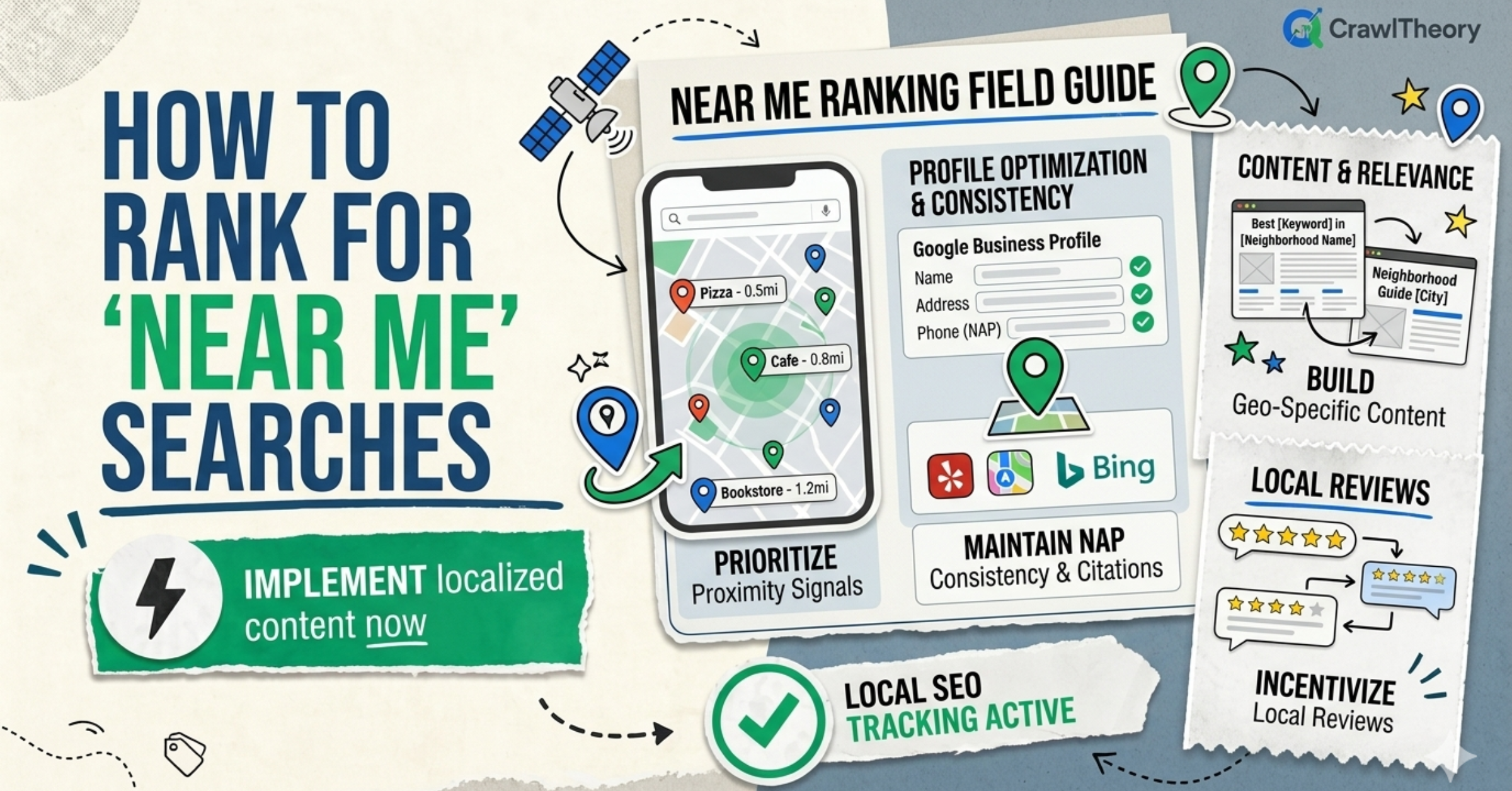
Someone nearby pulls out their phone and types “plumber near me.” Within seconds, three businesses appear in the Google local pack. One of them gets a call. The other two don’t exist to that person.
That’s the reality of near me searches in 2026— and it’s happening billions of times a month across every category you can think of.
Near me searches happen on Google every single month. 46% of all Google searches have local intent.
After working on local SEO over the years — from single-location restaurants to multi-city service businesses — we’ve seen what actually moves the needle. This guide skips the theory and gives you the practical steps that genuinely help businesses show up when it matters most.
What “Near Me” Really Means in 2026
When someone types “cafe near me” or “electrician near me,” they’re not actually searching for the phrase “near me.” They’re telling Google: “I have immediate intent and I want something close to where I am right now.”
Google figured this out years ago. It no longer treats “near me” as a keyword to match literally. Instead, it treats it as a proximity signal — a trigger to show results ranked by how close, relevant, and reputable a business is to the searcher’s current location.
Stuffing “near me” into your page titles or content doesn’t help you rank for near me searches. We’ve tested this across multiple sites. Google’s algorithm is smarter than that. What matters is your local relevance, geographic signals, and reputation — not the phrase itself.
There’s another shift worth understanding: Google now automatically infers local intent even without “near me” in the query. A mobile user who searches “coffee shop” or “dentist” on a phone with location services enabled triggers local results in the vast majority of cases. The near me behaviour is baked into how mobile search works.
76% Of people who search for something nearby on their phone visit a related business within 24 hours. 28% of near me searches result in a purchase.
This transactional intent is exactly why ranking for near me searches is worth prioritising over almost every other type of keyword.
The Three Factors Google Uses to Rank Near Me Results
Google is transparent about this. Its local ranking algorithm evaluates every business on three things. Understanding them is the foundation of everything else in this guide.
1. Relevance — Does Your Business Match the Search?
Relevance is about how well your entire online presence — your Google Business Profile, your website, your categories — matches what the person is looking for. A plumbing business that has clearly communicated it does emergency drain repairs is more relevant to “emergency drain repair near me” than one that just says “plumbing services.”
Relevance is largely in your control. Every piece of your local presence should signal clearly and consistently what you do, who you serve, and where you do it.
2. Distance — How Close Are You?
Distance is the proximity between your business location and the searcher. You cannot change where your business is located. But distance alone doesn’t determine rankings — it’s one input among many. Businesses further from a searcher regularly outrank nearby competitors by winning on relevance and prominence.
For service-area businesses (plumbers, cleaners, electricians), specifying your service area on Google Business Profile helps Google understand where you operate, even if you don’t have a storefront.
3. Prominence — How Well-Known and Trusted Are You?
Prominence is the sum of your online reputation: reviews, ratings, links from local websites, citations in directories, and engagement on your Google Business Profile. A business with 200 four-star reviews and active posts will be treated as more prominent than a competitor with a sparse, neglected profile.
Because proximity-based queries heavily rely on mobile devices, you’ll want to segment your mobile vs. desktop conversions. You can set up these custom device segments easily by learning through GA4 for beginners.
In our work across local businesses, prominence is the factor most businesses ignore and the one with the highest ROI to fix. Review velocity (getting new reviews consistently, not just in bursts) is one of the strongest signals we’ve seen shift local rankings.
Step 1: Optimise Your Google Business Profile Properly
Your Google Business Profile (GBP) is the single most important asset for near me visibility. It’s what populates the local pack — those three businesses that appear above organic results on most local searches.
42% of local searchers click directly on the Google local 3-pack. Businesses in the 3-pack receive 93% more actions — calls, website clicks, and direction requests.
Here’s how to actually optimise it, not just fill it in:
Choose Your Primary Category Carefully: Your primary category is the single most influential field in your GBP. It defines how Google classifies your business. Choose the most specific and accurate category that describes your core offering. If you run a Thai restaurant, “Thai Restaurant” is better than “Restaurant.” Add secondary categories (up to 9) to widen your relevance footprint without drifting into inaccurate territory.
Fill In Every Field — Completely: Business name, address, phone number, website, hours (including special hours), services, products, business description, attributes — complete everything. Incomplete profiles lose to complete ones. Complete profiles get significantly more views and customer actions than neglected ones.
Write a Business Description That Signals Relevance: Your 750-character business description is a relevance signal. Use natural language that describes what you do, who you serve, and where you operate. Mention your city or service area. Don’t keyword-stuff — write for a customer first, but be specific about your services.
Keep It Active: Posts, Photos, Q&A: A GBP isn’t a directory listing you set up once. Google treats activity as a signal. Post weekly updates — offers, new services, events, tips. Add photos regularly. Monitor and answer questions in the Q&A section. These are ranking signals, not decoration.
Across multiple local campaigns, businesses that posted to GBP weekly and consistently added photos outperformed less active competitors in the same category and service area — even when the less active business had more reviews.
Step 2: Get Your NAP Consistency Right
NAP stands for Name, Address, and Phone Number. Consistency across every platform where your business appears is a foundational trust signal for Google.
If your GBP lists you as “42 Main Street” but Yelp shows “42 Main St” and your website says “42, Main Street,” Google sees inconsistency. That inconsistency erodes trust in your business data and hurts your local rankings.
Audit your NAP across the following:
- Google Business Profile
- Your website — contact page, footer, and any location pages
- Yelp, Facebook, Apple Maps, Bing Places
- Industry-specific directories relevant to your business type
- Local chamber of commerce or business association listings
Use a tool like BrightLocal or Whitespark to audit your citations at scale. Fix inconsistencies before building new citations.
Step 3: Build a Consistent Review Strategy
Reviews influence near me rankings in two ways: they build prominence (a direct ranking factor), and they influence whether someone who finds you actually contacts you.
98% of consumers read online reviews before deciding on a local business. 67% often or always check reviews after conducting a local search.
The key word is consistency. One burst of 50 reviews followed by six months of nothing is less effective than getting 5–10 reviews per month steadily. Google’s algorithm rewards recency and velocity, not just volume.
How to Get Reviews Without Being Spammy
The most effective method is also the simplest: ask, at the right moment. Ask in person after a positive interaction. Send a follow-up email or SMS with a direct link to your GBP review page. Make it as easy as possible — any friction loses the review.
Never incentivise reviews (against Google’s policies) and never ignore negative ones. Responding to negative reviews professionally shows future customers how you handle problems. It also signals to Google that you’re an active, engaged business.
We’ve seen businesses in competitive local categories move from position 7–8 in the local pack to the top 3 purely through a structured review-generation process — without any other changes. Review velocity is consistently underestimated.
Step 4: Optimise Your Website for Local Relevance
Your website works in tandem with your GBP. It needs to reinforce your local relevance signals and give Google additional confidence that you are who you say you are.
Create Dedicated Service and Location Pages: If you offer multiple services, create a dedicated page for each one. If you serve multiple areas, create location-specific pages. A plumber in a city with five suburbs should have five location pages, each with unique content about that specific area — not duplicate pages with just the suburb name swapped out.
These pages should include your city and service naturally in headings, body copy, and meta tags. Don’t force keywords — write for the customer who lives in that area.
Embed a Google Map on Your Contact Page: This sounds minor but it’s a clear local relevance signal. Embed a Google Map showing your location on your contact or about page. Ensure your structured data (schema markup) includes your full address, phone number, and business type.
Use LocalBusiness Schema Markup: Add LocalBusiness schema markup to your website. This tells search engines and AI systems exactly what your business is, where it operates, your hours, and your contact details. It also improves your eligibility to appear in AI-generated answers for local queries.
Business websites make up 58% of results returned by ChatGPT for locally intended queries. Schema markup and clear, structured on-page content increase your chances of being cited in AI-generated local recommendations.
Page Speed and Mobile Experience: Near me searches are overwhelmingly mobile. A site that loads slowly or is difficult to navigate on a phone will lose visitors immediately — and Google’s algorithm accounts for this. Ensure your site loads fast on mobile, your phone number is tap-to-call, and your address links to Google Maps.
Optimizing your site architecture for user proximity is incredibly powerful, but it shouldn’t exist in a vacuum. It must be paired with an ongoing, broader framework for local search optimization.
Step 5: Build Local Links and Citations That Actually Matter
Generic directory listings have diminishing value. What actually moves the needle for near me rankings is local authority — links and mentions from sources that Google associates with your geographic area.
These include:
- Local newspapers and regional news websites
- Neighbourhood and community blogs
- Local chambers of commerce and business associations
- Sponsorship of local events, sports teams, or charities
- Partnerships with complementary local businesses
These links send geographic relevance signals that generic directories never will. A mention in your local newspaper’s business section is worth more to your near me rankings than 50 generic directory submissions.
The practical approach: think about what your business can do in the community that would naturally generate coverage or links. Host a local workshop. Sponsor a charity run. Create a genuinely useful local resource. When locals and local publications link to you, Google follows their lead.
Common Mistakes That Kill Near Me Rankings
After auditing hundreds of local SEO setups, these are the patterns we see most often:
- Adding “near me” to page titles and content: This does not help and can look spammy. Google determines proximity from location data, not from the phrase appearing on your page.
- Inconsistent NAP across platforms: Even small variations create conflicting signals and hurt trust.
- A neglected Google Business Profile: No posts, outdated photos, no review responses. Google sees this as low engagement.
- No location or service pages on the website: A homepage alone is insufficient for businesses serving multiple areas.
- Chasing reviews in bursts: 40 reviews in a week then nothing for 6 months looks manipulative. Steady velocity wins.
- Ignoring the Q&A section on GBP: Unanswered questions, or worse, questions answered by random members of the public with wrong information.
Near Me Searches in the Age of AI Search
AI-powered search (Google AI Overviews, ChatGPT, Perplexity) is changing how local results surface — but the fundamentals remain the same. Businesses that rank well in traditional local search also tend to appear in AI-generated local recommendations.
What’s new: AI systems read and synthesise your website content, reviews, and structured data to determine if you’re a trustworthy local recommendation. This makes clear, well-organised website content and accurate schema markup more important than ever.
One important data point: only 68% of business contact information on ChatGPT and Perplexity currently matches details on Google Business Profiles. If your information is inconsistent, AI systems may surface incorrect details — or not surface you at all. NAP consistency is an AI optimisation issue now, not just a local SEO one.
For the full framework, see how to get your website listed in AI search results.
Quick Wins to Start With
If you’re new to local SEO or doing an audit, here’s the order we’d tackle things in:
- Claim and verify your Google Business Profile if you haven’t already
- Complete every field in GBP, especially your primary category, description, and services
- Audit your NAP consistency across your website, GBP, and major directories
- Set up a simple, consistent process for asking customers for reviews
- Create or improve your location and service pages on your website
- Add LocalBusiness schema markup to your site
- Start posting to GBP at least once a week
- Identify two or three local organisations, publications, or events where you can earn a genuine mention
Near me-Questions People Ask
Q1: Should I add “near me” to my website content and meta titles?
No. Google determines proximity from your device’s location data, not from the phrase “near me” appearing on your page. Adding it to meta titles won’t help you rank for near me searches. Focus instead on your Google Business Profile, NAP consistency, and local relevance signals.
Q2: How important is the Google Business Profile for near me rankings?
It’s the single most important asset for appearing in the local pack — the top 3 results that get the majority of clicks for local searches. Without a well-optimised GBP, it’s very difficult to rank for near me searches regardless of how good your website is.
Q3: How many reviews do I need to rank in the local pack?
There’s no magic number — it depends on your category and local competition. What matters more than total count is recency and velocity. A business getting 8–10 new reviews per month consistently will outperform one that got 100 reviews two years ago and has since gone quiet.
Q4: Can I rank for near me searches without a physical address?
Yes, for service-area businesses (plumbers, cleaners, mobile services). Set up your GBP as a service-area business, specify the areas you serve, and hide your home address if you work from home. Your ranking radius originates from your verified address even if it’s not publicly shown.
Q5: How long does it take to rank for near me searches?
With consistent effort on GBP optimisation, NAP cleanup, and reviews, most businesses start seeing movement in 60–90 days. Highly competitive categories in dense urban areas may take longer. Local SEO compounds — results improve over time with sustained effort.
Q6: Do near me searches work differently on AI tools like ChatGPT?
AI tools are increasingly used for local discovery, and they rely on the same signals — your website content, structured data, GBP accuracy, and reviews. Keeping your business information consistent across all platforms (especially ensuring it matches your GBP) is critical for AI search visibility.
Final Thought
Near me searches are the highest-intent queries in local search. The person who types “electrician near me” at 9pm has already made a decision to hire someone — they’re just deciding which business gets the call.
Winning that call doesn’t require a big budget or complex strategy. It requires a complete, accurate, and actively maintained Google Business Profile; a consistent local presence across the web; a steady stream of genuine reviews; and a website that clearly communicates what you do and where you do it.
These are the same things we’ve applied across 300+ websites over five years. The businesses that do them consistently are the ones that show up.