
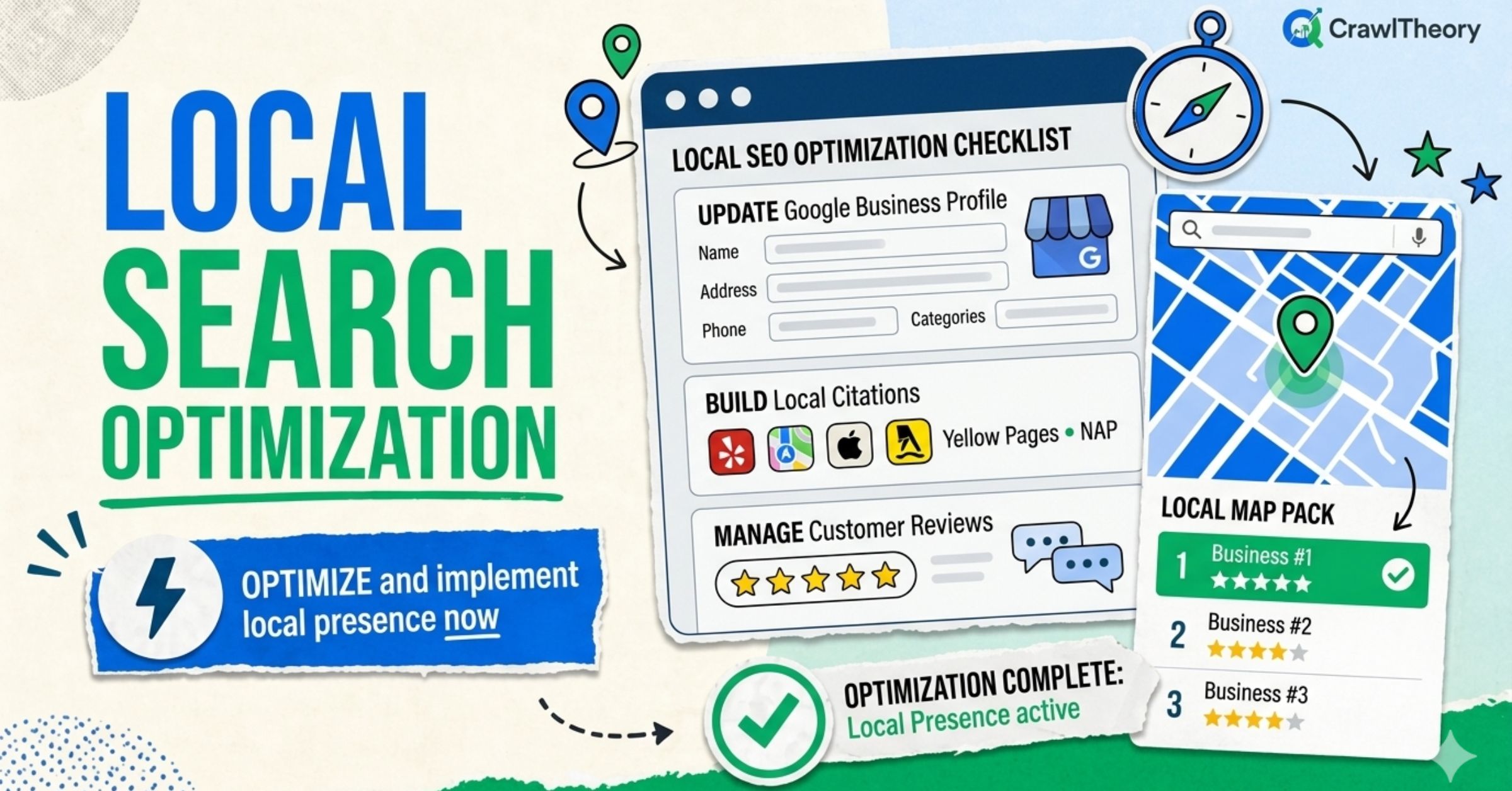
Most businesses treat local search optimization as a to-do list: claim the Google Business Profile, collect some reviews, and add the address to the website footer. And then they wonder why the phone is not ringing.
A checklist is not a strategy. A strategy is a prioritised, interconnected set of actions that work together to tell Google — and the customer — exactly what you do, where you do it, and why you are the right choice.
This post lays out that framework. Not every tactic in existence, but the structure that makes the tactics work. After five years across 300+ websites in competitive markets, the businesses that dominate local search are not the ones doing the most. They are the ones with the clearest, most consistent system.
If you are completely new to this topic, you may want to start with our basic overview explaining what is local seo marketing before diving into these advanced optimizations.
What Local Search Optimization Actually Means
Local search optimization is the process of structuring your entire online presence — your Google Business Profile, your website, your citations, your reviews, and your technical setup — so that Google can confidently recommend your business to nearby searchers.
The word optimization is key here. It is not about being present. It is about being better calibrated to Google’s local algorithm than your competitors in your area. You are not competing against the whole internet. You are competing against businesses in your postcode, city, and service area.
That distinction matters because it changes the competitive bar entirely. The question is not how do I rank globally? It is what are the three businesses sitting in my Local Pack doing — and what are they not doing — that I can do better?
The most common mistake when businesses begin local search optimization is spending effort on tactics before understanding the competitive baseline. Run a search for your target keywords in your area before doing anything else. See who is in the top three. Study what they have done well and where the gaps are. That analysis tells you exactly where to spend your time.
The Four Pillars of a Local Search Optimization Strategy
Every local search optimization tactic belongs to one of four pillars. Every ranking gain comes from strengthening one or more of them. Neglect any one pillar, and the other three underperform. Here is the framework:
Pillar 1: Google Business Profile (GBP) Signals
GBP signals account for roughly 32% of Local Pack rankings (Moz). This is the most direct lever available. A fully completed, regularly updated, and actively managed GBP is the single highest-ROI action in local search optimization. See our guide on how to optimize your Google Business Profile for a deeper breakdown of each GBP element.
- Primary and secondary category: be specific, not broad — choose the most precise category Google offers
- Service list with a description for every service you offer, using the natural language your customers use
- Business description: clear, keyword-informed, written for a human first
- Photos: interior, exterior, team, product or service images — refresh monthly
- Google Posts: weekly updates, offers, or events — signals that your business is active
- Q&A: seed it with 3–5 questions you are commonly asked, and answer them yourself
- Review responses: every review, within 48 hours, positive and negative
Pillar 2: On-Page Website Signals
Your website reinforces and extends what your GBP communicates. Our on-page SEO checklist covers each element. It needs to tell Google the same story — who you are, what you offer, where you operate — in a format Google can crawl, read, and trust.
- Homepage title tag: include your primary service and city or area
- Dedicated location pages for each city or service area you cover — with unique, locally relevant content for each
- Separate service pages for each core offering — not one combined generic page
- NAP (Name, Address, Phone) in the website footer, matching GBP exactly — character for character
- LocalBusiness schema markup on the homepage and all location pages
- Internal linking: homepage links to location pages, location pages link to relevant service pages
- Local context in content: reference nearby landmarks, neighbourhood names, area-specific considerations
Pillar 3: Off-Page Authority Signals
Off-page signals tell Google how the rest of the internet perceives your business. This pillar covers citations, third-party reviews, and backlinks from sources that are geographically or topically relevant to your area.
- Core citations: consistent NAP on Google, Bing Places, Apple Maps, Yelp, and industry-specific directories
- Review quantity, rating, recency, and diversity across Google and relevant third-party platforms
- Local backlinks: chamber of commerce, local press coverage, community event sponsorships, local blogs
- Unstructured citations: mentions of your business in local news, forum threads, neighbourhood community posts
- Social presence: active accounts on platforms your local audience actually uses
While standard directory consistency is critical, capturing high-intent mobile users requires a proximity-focused approach. Dive deep into our guide on how to rank for near me searches to capture local demand.
Pillar 4: Technical Foundations
Technical issues do not make you rank higher when fixed — they stop you from being penalised when they are present. A technically sound site is the floor that everything else rests on. Without it, the other three pillars underperform.
- Mobile-first performance: pages load under 3 seconds on mobile — check with Google PageSpeed Insights
- HTTPS: SSL certificate in place, no mixed content warnings across any page
- Core Web Vitals: LCP, CLS, and INP within Google’s recommended thresholds
- Crawlability: no orphaned location pages, clean internal linking, no broken redirects
- Structured data: LocalBusiness, FAQPage, and BreadcrumbList schema validated via Google’s Rich Results Test
After deploying these technical updates, monitor changes in your organic geographical traffic. We recommend using a structured approach to tracking via GA4 for beginners to isolate your local organic landing pages.
How to Prioritise Your Local Search Strategy
The four pillars do not carry equal weight at every stage. Here is how to sequence your effort based on your starting point:
Where to Start — Based on Where You Are
Not every business begins from the same place. Match your situation to the right starting point and follow the sequence from there.
You have no GBP and no website optimisation
- First 30 days: Claim and verify your GBP. Complete every field. Fix NAP consistency across all existing listings.
- Days 31–90: Add location pages to your website. Begin review outreach. Submit to core citation directories.
Your GBP is claimed, but fields are incomplete
- First 30 days: Fill every GBP field. Upload photos. Respond to all existing reviews.
- Days 31–90: Build dedicated location and service pages. Add schema markup. Begin local link outreach.
Your GBP and website are active, but reviews are thin
- First 30 days: Launch a systematic review generation process. Audit and fix any NAP inconsistencies.
- Days 31–90: Create locally-relevant content. Build local backlinks. Improve mobile page speed.
You’re established, but rankings have plateaued
- First 30 days: Audit competitor GBPs and websites. Map their citation sources and backlink profile.
- Days 31–90: Close the gaps — stronger content, more specific location pages, hyperlocal link building.
One principle holds across all starting points: resolve foundational issues before layering advanced tactics on top. Link building on a broken NAP or an incomplete GBP produces weak results. The sequence matters as much as the tactics.
The Local Search Optimization Audit Checklist
Before adding any new activity, run this audit. ”✓” is your baseline. ”!” is costing you rankings right now.
✓ GBP claimed and verified
✓ All GBP fields complete: name, address, phone, hours, website, category, services, description, attributes
! At least 5 photos uploaded (interior, exterior, team, product or service)
! GBP posts published within the last 30 days
! Every review is responded to within 48 hours
! Q&A seeded with 3–5 relevant questions and answers
! NAP identical on GBP, website footer, and all directory listings
! Business listed on Bing Places, Apple Maps, Yelp, and 3+ industry directories
! Homepage title tag includes primary service and city or area
! Dedicated location page for each city or service area served
! LocalBusiness schema implemented and validated in Rich Results Test
! Website loads under 3 seconds on mobile (Google PageSpeed Insights)
! At least one local backlink from a non-directory, locally relevant source
! Minimum 2 new reviews received per month (review velocity)
Items 1–6 (GBP) come first. Items 7–8 (citations) run in parallel. Items 9–11 (on-page) follow. Items 12–14 (technical and off-page) are ongoing. If more than four items in the GBP section are unchecked, do not move to advanced tactics yet. The foundation must be solid before advanced strategies produce consistent results.
What a Local Search Strategy Is Not
Knowing what to avoid saves as much time as knowing what to do. These are the most common misdirected efforts we see:
Keyword stuffing in the GBP name. Adding keywords to your business name — such as ‘Mike’s Plumbing | Best Plumber in Delhi’ — violates Google’s guidelines and risks suspension of your listing. Use your real, registered business name only.
Building dozens of low-quality citations. Twenty consistent, accurate citations on relevant platforms outperform two hundred inconsistent ones on obscure directories. Quantity without quality is noise. Google is looking for consistency across credible sources, not raw volume.
Location pages with only the city name swapped. A page that reads identically to another except for the city name does not rank. Google identifies thin, templated content. Each location page must have genuinely unique content that reflects the specific area it serves: local context, area-specific language, relevant testimonials.
Treating reviews as something to manage reactively. Review management is proactive. Businesses that ask for reviews consistently and respond to all of them outperform those that only engage when a negative review appears. The review velocity — how regularly new reviews arrive — is itself a ranking signal.
Treating local search optimization as a one-time project. Local search is a live environment. Competitors update their profiles. Google updates its algorithm. Customer search behaviour evolves. The businesses that stay visible treat optimization as a continuous process, not a completed task.
Quick Questions & Answers
What is local search optimization?
Local search optimization is the process of structuring your online presence — GBP, website, citations, reviews, and technical setup — so Google consistently recommends your business to nearby searchers looking for what you offer.
How is it different from general SEO?
General SEO competes nationally or globally, prioritising content authority and domain-level backlinks. Local search optimization competes within a geographic area, prioritising GBP signals, NAP consistency, local citations, reviews, and proximity-based ranking factors.
What are the four pillars of a local search optimization strategy?
GBP signals (profile completeness and ongoing activity), on-page signals (website structure, location pages, schema), off-page signals (citations, reviews, local backlinks), and technical foundations (mobile performance, speed, structured data).
What should I prioritise first in my local search strategy?
Your Google Business Profile. A fully completed and actively managed GBP account for roughly 32% of Local Pack rankings. Resolve every gap there before moving to website on-page work, then citations and reviews, then technical and link building.
How do I know if my local search strategy is working?
Track GBP Insights (views, calls, direction requests), local keyword rankings via a geo-specific rank tracker like BrightLocal or Whitespark, and organic traffic to location and service pages via Google Search Console. Review these monthly.
Can a new business compete with established local competitors?
Yes, specifically in the Local Pack. A new business with a complete GBP, 15–20 genuine reviews, and consistent NAP can outrank a long-established competitor with a neglected profile. Google’s local algorithm rewards relevance and activity, not just business age.
How often should I revisit my local search strategy?
Monthly for GBP activity and metrics review. Quarterly for a full audit: check citation consistency, review competitor profiles, refresh location page content, and confirm your category and service selections still accurately reflect your current offer.
The Bottom Line
Local search optimization is not complicated — but it is systematic. The four pillars — GBP, on-page, off-page, and technical — do not work in isolation. Strengthen one without the others, and you leave ranking potential on the table.
The businesses that consistently appear in the Local Pack are not doing anything exotic. They have a complete, active GBP. Their website clearly states what they do and where. Their NAP is consistent everywhere. They have a steady flow of reviews and at least a few local backlinks that signal genuine community relevance.
Start with the audit checklist above. Prioritise based on where you are starting from. Build systematically from there.
Find this insight valuable? We publish new content all the time! Visit The Crawl Theory Home, master search with our step-by-step SEO Guides, stay ahead with the latest SEO News, or access our helpful SEO Resources.