
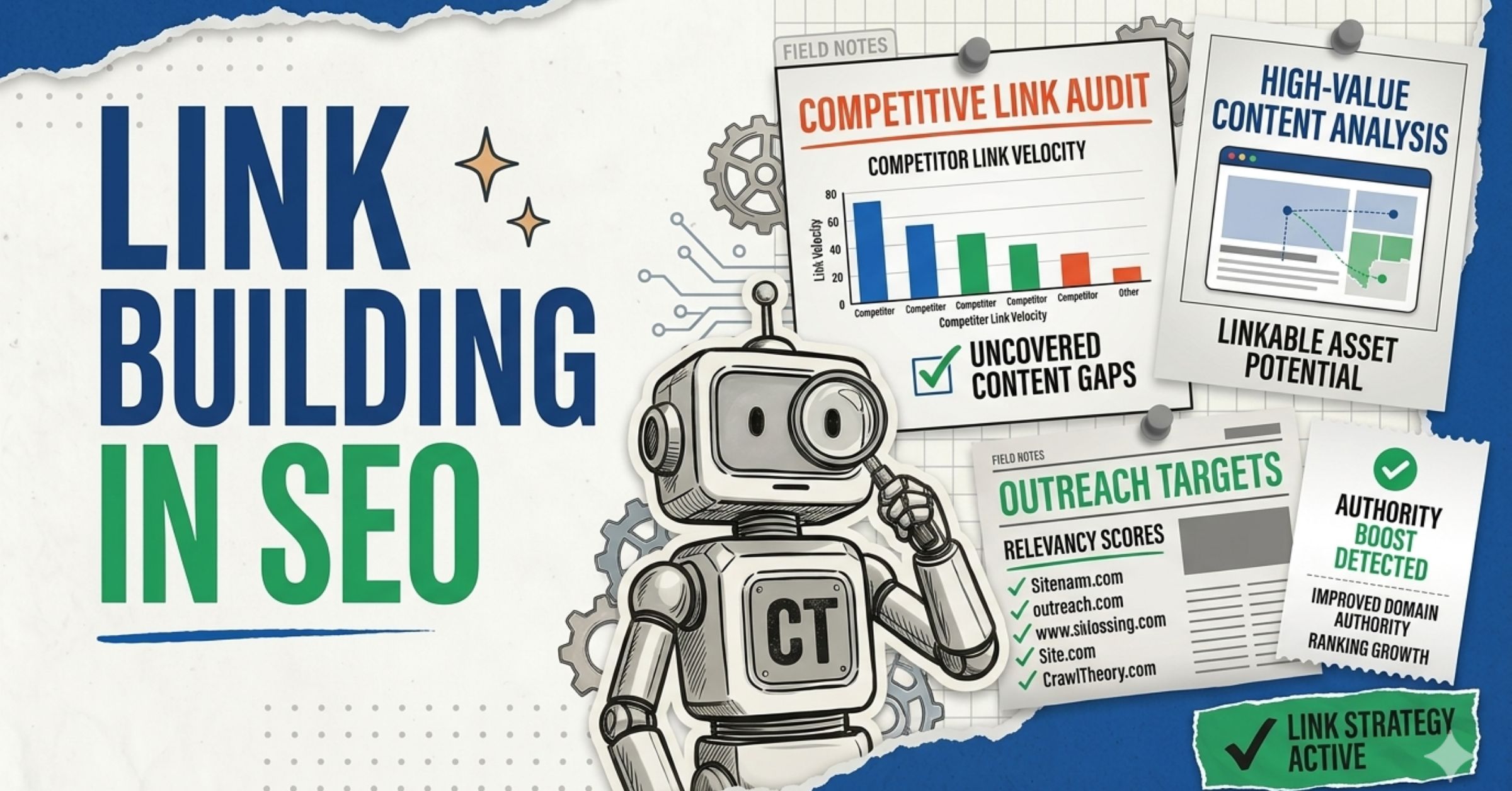
Link building = earning votes for your website. The more relevant, trustworthy websites that link to you, the more search engines and AI tools believe your content deserves to be seen.
What Is Link Building in SEO?
Link building in SEO is the process of getting other websites to place a link that points to your website. That link is called a backlink (because it points back to you).
Think of the internet as a giant network of roads. Links are the roads that connect one page to another. When a website links to you, it builds a road that both people and search engines can travel down to reach your page.
Here’s the simplest way to picture it:
- Your page is a shop.
- A backlink is a signpost on someone else’s street pointing to your shop.
- The more trusted streets that point to you, the easier you are to find — and the more important you look.
Without any links pointing to it, a page is like a shop with no signposts and no road leading in. Search engines may struggle to even find it, let alone rank it.
Ahrefs research has repeatedly found that a huge share of web pages have zero backlinks pointing to them. That means simply earning a few good, relevant links can put you ahead of most of your competition.
Links work best when your page is already worth linking to. Even the best backlink struggles to rank a thin, poorly optimized page — so pair your link building with a solid on-page SEO checklist so the links you earn have something strong to point at.
A backlink is any link on another website that points to a page on your website. It works like a recommendation: the site linking to you is telling search engines and readers that your page is worth visiting.
They’re closely related. A backlink is the link itself. Link building is the activity of earning those backlinks through good content, outreach, and relationships.
Why Does Link Building Matter for SEO?
Link building matters because backlinks are one of the ways Google decides which pages to trust and rank. When a respected website links to you, Google treats it as a signal that your content is credible.
Backlinks help your SEO in three main ways:
- Discovery — Links help search engines find your pages in the first place. Crawlers follow links from page to page.
- Authority — Links from trusted, relevant sites make your site look more credible. More credibility usually means better rankings in competitive topics.
- Referral traffic — Real people click links. A link on a popular, relevant page can send you genuine visitors, not just SEO value.
You can rank without backlinks for very specific, low-competition, long-tail searches. But in competitive industries — law, SaaS, finance, home services — links are often the deciding factor between page one and page five.
How much do links matter in 2026?
This is where beginners get confused, so let’s be clear and honest.
Google’s John Mueller has said multiple times that the weight on links has been dropping as Google gets better at understanding content in context. Links still matter — Google needs them to find pages — but they’re no longer the single dominant factor they once were.
What this means for you as a beginner:
- Don’t obsess over link counts. A handful of relevant, trusted links beats a pile of random ones.
- Don’t ignore content. Links amplify good content; they can’t rescue bad content.
- Don’t chase shortcuts. The tactics that “worked” a decade ago now do nothing — or hurt.
If you’ve read older guides promising fast results from buying links or spamming forums, be careful — many of those claims are flat-out SEO myths that are wasting your money.
Before you build a single link, set up Google Search Console so you can see which sites already link to you and which pages earn them. You can’t improve what you can’t measure.
Yes, but with nuance. Google has said the importance of links has decreased as its systems better understand content. Links still help with discovery, authority, and traffic — especially in competitive niches — but they work best alongside genuinely helpful content.
Sometimes. For very specific, low-competition long-tail queries, strong on-page content can rank with few or no backlinks. For competitive keywords, backlinks usually remain essential.
What Makes a “Good” Backlink? (The Beginner’s Checklist)
Not all links are equal. A single link from a trusted, relevant site can be worth more than hundreds of weak ones. Here’s how to judge a link in plain English.
A good backlink usually checks these boxes:
- Relevance — The linking site is about a topic related to yours. A link from a gardening blog to a gardening shop makes sense. A link from a random gambling site does not.
- Trust — The site has a real audience, real editorial standards, and isn’t stuffed with spam.
- Context — The link sits inside helpful content, with anchor text that describes where it goes (like “beginner’s SEO guide” instead of “click here”).
- Placement — A link inside the main body of an article carries more weight than one buried in a footer or sidebar.
- It stays live — A link that gets removed next month does little for you. Lasting links are crawled and counted over time.
Google’s John Mueller has said the total number of links to a site is largely irrelevant — one good link from a relevant website can matter more than millions of low-quality ones.
A quick word on “DA” and “DR” scores
You’ll hear beginners obsess over Domain Authority (DA) from Moz or Domain Rating (DR) from Ahrefs. Here’s the truth:
- These are third-party scores, not Google ranking factors.
- Google’s John Mueller has directly confirmed domain authority is not something Google uses.
- They’re useful as a rough credibility shortcut — but never the whole story.
At CrawlTheory, across 300+ websites, we treat DA/DR as one quick signal among many. Relevance and trust always come first. A relevant DA-20 industry blog often beats an irrelevant DA-70 general site.
Chasing high DA/DR numbers while ignoring relevance is one of the most common — and costly — SEO mistakes to avoid. A relevant link beats an impressive-looking irrelevant one almost every time.
Dofollow vs. Nofollow links (kept simple)
- Dofollow link: The standard link. It can pass authority and help rankings.
- Nofollow link: Has a tag telling search engines “don’t pass authority through this.” Still useful for traffic, brand exposure, and a natural-looking link profile.
A healthy link profile has a natural mix of both. If every link is a perfect dofollow with exact-match anchor text, it looks manipulated.
Relevance. A link from a site closely related to your topic sends the strongest, safest signal. Trust and natural placement come next. High authority scores matter far less than beginners think.
No. Nofollow links don’t pass ranking authority the way dofollow links do, but they still bring referral traffic, build brand awareness, and make your overall link profile look natural. A mix of both is healthy.
What Are the Different Types of Backlinks?
There are three broad categories of backlinks. Understanding them helps you know which to pursue and which to avoid.
| Type | What it is | Risk level | Beginner verdict |
|---|---|---|---|
| Earned links | Other sites link to you because your content is genuinely useful | Lowest | Best — aim for these |
| Built / outreach links | You ask for the link (guest posts, resource pages, journalist requests) | Low–medium | Good, when done honestly |
| Self-created links | Links you place yourself (directories, profiles, comments) | Medium–high if overdone | Use sparingly and carefully |
Earned links are the gold standard. They happen naturally when your content is so helpful that people reference it. They scale slowly but safely.
Built links are perfectly fine when you’re providing real value — for example, writing a genuinely useful guest article or being a helpful source for a journalist. This is the “digital PR” approach Google has openly praised.
Self-created links include directory listings and profile links. A few relevant ones (like an accurate business listing) are fine. Mass-creating them is a red flag.
Buying links purely to pass ranking value violates Google’s spam policies. Even if it seems to work briefly, Google’s systems are built to detect and ignore — or in serious cases, penalize — paid link schemes.
If you run a local business, your most valuable early “links” are often accurate citations and listings — a core part of local search optimization that builds trust without any risk.
Earned links from helpful content are safest and most valuable. Beginners can also do well with honest outreach — guest posting on relevant sites and responding to journalist requests — as long as the goal is providing real value, not just dropping a link.
Yes, when they’re relevant and accurate — especially for local businesses. A few quality, niche-relevant listings help. Mass-submitting to hundreds of low-quality directories does not and can look spammy.
What Links Should Beginners Avoid?
Some links do nothing. A few can cause real harm. Here’s what to stay away from while you’re learning.
Avoid these:
- Bought links that exist only to pass ranking value.
- Private Blog Networks (PBNs) — fake networks of sites built to sell links.
- Mass forum and comment spam — dropping your link in unrelated comment sections.
- Irrelevant link exchanges — “you link to me, I link to you” with unrelated sites.
- Spun, low-quality guest posts on sites that publish anything for a fee.
The common thread? They’re all attempts to trick search engines instead of earn trust.
But what about “toxic” links pointing to me?
Here’s reassuring news for nervous beginners. Google has become very good at simply ignoring spammy links. Its guidance has been consistent:
- If Google finds spammy links, it typically just stops counting them — no penalty, no action needed from you.
- John Mueller has advised site owners not to obsess over toxic backlinks you didn’t create.
- The disavow tool should be used rarely — mainly if you paid for links and need to clean up. For random spam you didn’t build, Google generally recommends leaving it alone.
Don’t rush to disavow links the moment a tool flags them as “toxic.” Used carelessly, the disavow tool can remove links that were actually helping you. When in doubt, do nothing.
Instead of fighting spam links you didn’t create, spend that energy earning one genuinely great link. It’s a far better use of your time and almost always more impactful.
Usually not. Google’s systems are designed to ignore most spammy links automatically rather than penalize you for links you didn’t create. Manual penalties are reserved for clear, deliberate manipulation like paid link schemes.
Rarely. Google recommends the disavow tool mainly for cases where you paid for links and need to distance yourself from them. For random spam links you didn’t build, the safest move is usually to leave them alone.
How Do Links Help You Show Up in AI Search?
This is the biggest shift from older link-building guides — and where most of them fall short. In 2026, links don’t just affect blue-link rankings. They also influence whether AI tools mention your brand.
Here’s how it works in plain English:
- AI tools like ChatGPT, Perplexity, Gemini, and Google AI Overviews learn about the web partly through how brands are linked and mentioned.
- When trusted sites link to you and mention you alongside a topic, these tools start associating your brand with that topic. This is sometimes called a co-citation.
- Over time, consistent links and mentions build what’s often called topical authority — being known as a go-to source for a subject.
So the goal of link building has quietly expanded: it’s no longer just about ranking, it’s about being discoverable and quotable by AI.
If your goal is visibility inside AI answers specifically, pair this chapter with our guide on how to get your website listed in AI search results.
The good news from our work across 300+ sites: you don’t need a separate “AI strategy.” Strong fundamentals — helpful content, relevant links, and clear structure — feed both Google and AI. Our answer engine optimization best practices build directly on the same foundations covered here.
A practitioner pattern we’ve seen repeatedly: a business that consistently publishes helpful, well-linked content on one focused topic eventually starts getting cited directly by AI tools to potential customers — sometimes bringing in leads who say “an AI recommended you.” That’s topical authority paying off.
Indirectly, yes. Links and mentions across trusted sites help AI systems understand what your brand is about and which topics to associate you with. The more consistently you’re linked and mentioned alongside a subject, the more likely AI tools are to surface you for it.
Not really. The foundations are the same as traditional SEO: helpful content, relevant links, clear structure, and topical authority. Get the basics right and you serve both Google and AI search at once.
A Real-World Example: Why Relevance Wins
Theory is one thing; results are another. Here are two patterns we’ve seen firsthand across our client work that prove the principles in this chapter.
Case 1 — Volume with relevance worked. A cleaning service in Kalamazoo, Michigan, earned a steady stream of natural, relevant backlinks over several months. The result: 70+ keywords ranking on page one within five months, and organic leads roughly tripled. The key wasn’t a magic number of links — it was that the links were relevant to the niche and earned consistently.
Case 2 — Bad links required a cleanup. A different client came to us after a link-based penalty. Someone had built low-quality, manipulative links in the past. The fix wasn’t more links — it was disavowing the bad ones and rebuilding with genuinely helpful content. Recovery took about six months. The lesson: shortcuts cost far more time than they ever save.
The takeaway for beginners: chase relevance and consistency, not raw numbers or shortcuts.
If your rankings drop, don’t immediately blame backlinks. Google has said core updates rely on long-term patterns, not recent link spam. Check your content quality and technical health first — the cause is often there, not in your link profile.
How Do You Start Link Building as a Beginner?
You don’t need expensive tools or an agency to begin. Here’s a safe, simple starting sequence — we’ll go deeper in later link-building chapters.
- Know your starting point. Open Google Search Console and look at the Links report. See who already links to you and which pages earn them.
- Make something worth linking to. A genuinely useful guide, tool, or data piece earns links far more easily than a thin page.
- Study competitors. Look at the sites ranking above you and see where their links come from. Those sources are often open to you too.
- Reach out honestly. Offer real value — a helpful guest article, an expert quote, or a better resource than a broken link they currently use.
- Track and measure. Watch impressions, clicks, and keyword movement over time using your analytics.
To see whether your links are actually working, you’ll want a simple SEO keyword tracking routine so you can connect link-building effort to ranking movement.
And to measure the traffic those links bring — not just rankings — set up GA4 for beginners so you can see real organic visitors.
Pick one topic and go deep before going wide. Earning a cluster of relevant links around a single subject builds topical authority faster than scattering effort across unrelated pages.
The easiest beginner methods are creating genuinely useful content people want to reference, claiming unlinked brand mentions, writing helpful guest posts on relevant sites, and responding to journalist source requests. Start with relevance over volume.
There’s no universal number — it depends on your competition. In low-competition niches, a handful of relevant links may be enough. In competitive local or commercial niches, you may need dozens of natural, relevant links before you see movement. Quality and relevance always matter more than the raw count.
Chapter Summary
Link building in SEO comes down to one idea: earn trust, don’t fake it. Backlinks are votes of confidence, and the votes that count come from relevant, trustworthy sites — not from shortcuts. Links still help you rank and now help AI tools discover and quote you, but they work best on top of genuinely helpful content.
Here’s what to carry into the next chapter:
- A backlink is a recommendation; relevance and trust make it valuable.
- Links matter, but less than they once did — content quality leads.
- Most bad links are simply ignored by Google, so don’t panic over them.
- Strong fundamentals serve Google and AI search at the same time.
In Chapter 2, we’ll move from understanding links to finding them — how to research link opportunities, analyze competitors, and build your first prospect list step by step.
Intrigued by this topic? Keep your SEO momentum going strong! Loop back to The Crawl Theory Home, click through our step-by-step SEO Guides, scan the latest SEO News, or make use of our helpful SEO Resources.