
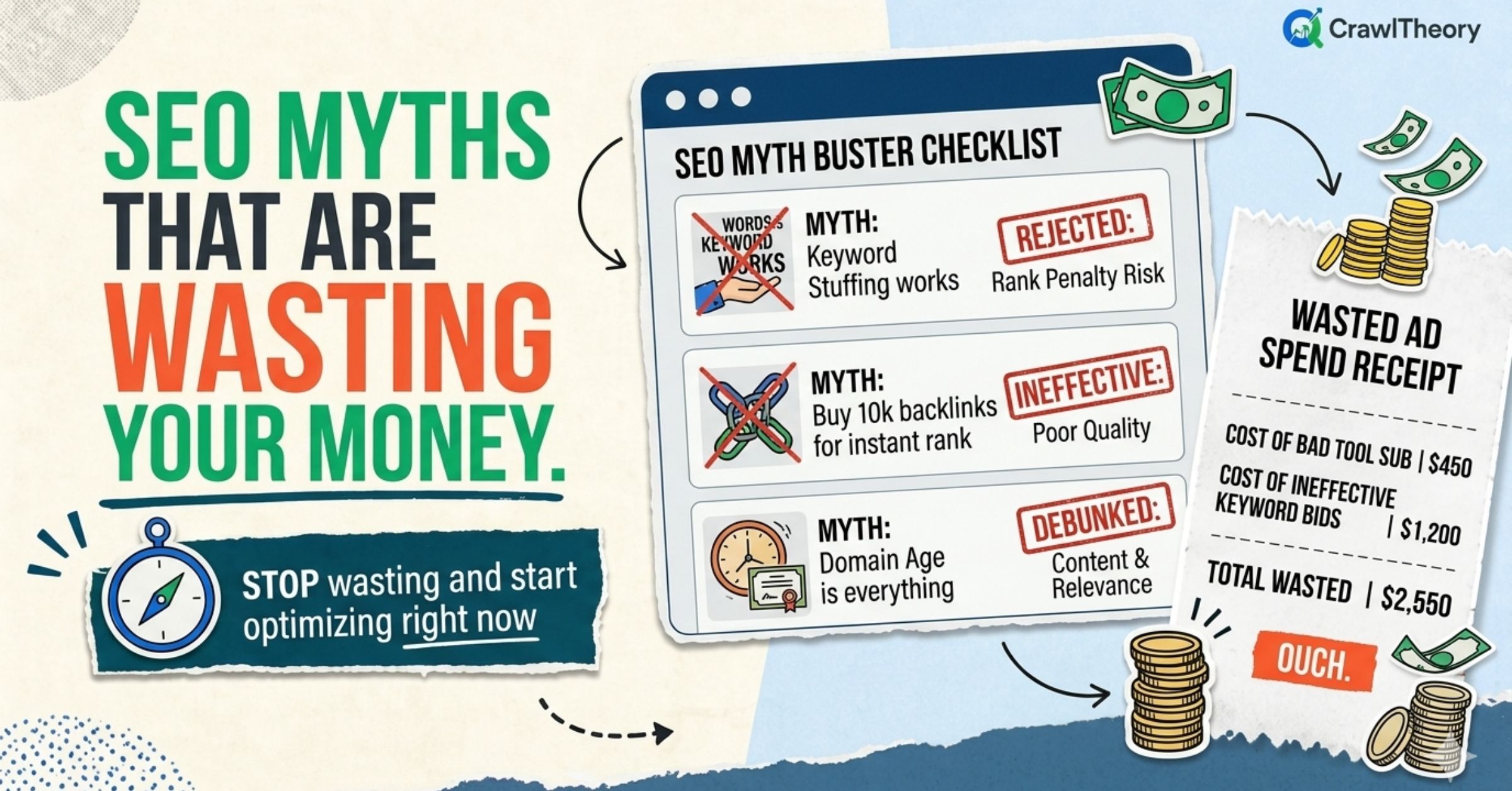
Every year, businesses spend thousands chasing SEO advice that stopped working years ago. The problem isn’t lack of effort — it’s bad information dressed up as expertise. After working on 300+ websites across industries and geographies, we’ve seen the same myths drain budgets repeatedly. This piece is our attempt to put an end to that.
This is not a list of theories. Everything here comes from real client work, real rankings, and real money either saved or wasted.
Myth #1: Is More Content Always Better for SEO?
The belief that publishing a high volume of articles will automatically improve your rankings — regardless of quality, depth, or relevance.
More content is only better if each piece earns its place. Publishing thin, repetitive, or poorly differentiated articles doesn’t compound — it dilutes. Studies show that 97% of web pages get zero organic traffic, and the same applies to local search — a thin location page ranks no better than a thin blog post. The problem isn’t that people aren’t creating content. The problem is that most content doesn’t bring anything new to the conversation.
What actually matters is information gain — bringing something to the table that Google hasn’t seen before. Word count alone doesn’t drive results. Focus on differentiation and unique value rather than hitting arbitrary volume targets.
What we see in practice: Clients come to us with 400+ blog posts, and less than 5% of them are driving any traffic. The fix is never to write more — it’s to consolidate, improve, and redirect.
Before creating a new piece, ask: Does this say something the top 10 results don’t? If the answer is no, you’re not creating content — you’re creating noise.
How often should I publish content for SEO?
There’s no universal frequency. One well-researched, user-focused article a month will outperform four thin articles a week. Consistency matters, but relevance matters more. Publish when you have something genuinely useful to say.
Should I delete old content that isn’t ranking?
Not necessarily. Before deleting, evaluate if the page can be improved, consolidated with a related piece, or redirected. Deletion without a redirect plan can cause crawl issues and drop internal link equity.
Learn more about on-page signals in our on-page SEO checklist to rank & stay that way.
Myth #2: Does Keyword Density Still Affect Rankings?
The idea is that repeating your target keyword a specific number of times on a page (typically 2–3%) will help it rank higher.
Google has not used keyword density as a ranking factor since the Panda update in 2011. Pages with a keyword density between 1–2% show no statistically significant correlation with higher rankings. 81% of SEO professionals say content relevance matters more than keyword frequency.
Analysis of over 1,500 Google search results shows no consistent correlation between keyword density and rankings. What does correlate is topic coverage. Google’s language models now understand meaning, synonyms, and search intent — not just repeated phrases.
What we see in practice: We’ve audited pages where the target keyword appears 40+ times in 1,200 words. They rank for nothing because the page never actually answers the user’s question. Meanwhile, a competitor with half the keyword mentions, but a clearer, more complete answer, ranks on page one.
What to do instead: Treat keyword suggestions as topics to cover, not phrases to force. Write like you’re explaining something to a knowledgeable friend — naturally.
Does using keywords in H2s and H3s help rankings?
Yes, but for the right reason. Structured headings help Google understand your content’s hierarchy and help users navigate the page. The benefit is clarity and relevance, not mechanical repetition.
Are LSI keywords important?
The term “LSI keywords” as commonly used in SEO is largely a myth. There’s no public evidence that Google uses LSI (Latent Semantic Indexing) as a ranking mechanism. What matters is covering the topic comprehensively, and using natural language — related terms will appear organically when you do that.
Myth #3: Is Domain Authority a Google Ranking Factor?
The assumption that improving your Domain Authority (DA) score from tools like Moz, Ahrefs, or SEMrush will directly improve your Google rankings.
This is one of the most expensive myths in SEO. Businesses pay agencies to “increase DA” as an end goal — spending money on link packages specifically targeted at improving a third-party score that Google doesn’t use.
Google has stated explicitly that it doesn’t use Domain Authority at all when it comes to search crawling, indexing, or ranking. Moz’s own website confirms this. The same applies to Ahrefs’ Domain Rating and SEMrush’s Authority Score. These metrics exist because third-party tools needed a way to estimate site strength — they’re not Google metrics. Improving your DA score doesn’t improve your Google rankings. Focus on what Google actually measures: quality content and legitimate backlinks from relevant sites.
What we see in practice: We’ve ranked pages on low-DA domains above established competitors with DA 70+. The deciding factor was that our content answered the query better and had a handful of genuinely relevant backlinks.
What to do instead: Stop reporting DA to stakeholders as a success metric. Report actual organic traffic, keyword rankings, and leads. Those reflect what’s happening in Google — DA does not.
If DA doesn’t matter, why do high-ranking sites tend to have high DA?
Correlation, not causation. Sites with high DA usually have it because they have many quality backlinks — the same signal that helps them rank. But it’s the backlinks doing the work, not the DA score itself.
Should I stop tracking DA entirely?
You can use it as a rough comparative benchmark when evaluating a potential link partner — a DA 60 site is likely more authoritative than a DA 10 site. But never treat it as a KPI or an SEO goal in itself.
Myth #4: Do More Backlinks Always Mean Better Rankings?
The belief that the total number of backlinks pointing to a site is the primary driver of rankings, and that more links always equal more ranking power.
Ten years ago, large numbers of backlinks could boost authority. But now, Google values relevant, trustworthy links from credible sources over sheer volume. This shift has been reinforced through multiple spam updates.
Low-quality backlinks from spammy sites harm your authority. Google’s 2025 Spam Update cracked down on manipulative links. Buying link packages, using PBNs, or running link exchange schemes can now result in manual penalties or algorithmic devaluation.
What we see in practice: A local business from New Jersey came to us after spending $3,000/month on a link-building package from a vendor promising 100 links per month. Two years in, traffic had barely moved. The links were going to irrelevant directories and unrelated blog networks. For local businesses specifically, the backlink calculus looks different — here’s the local authority framework we use; we replaced the strategy with 4–6 editorial links per month from niche-relevant publications, & 3-4 business listings every month. Rankings moved within 90 days.
A massive mistake brick-and-mortar brands make is applying national strategies to a local audience. To fix this, you must understand what is local seo marketing and how it differs from traditional SEO.
What to do instead: Focus on earning backlinks through genuinely useful content — original data, research, tools, or perspectives that people in your space actually want to reference.
How many backlinks do I need to rank?
There’s no fixed number. It depends entirely on your niche, the competition level of your target keyword, and the authority of the linking domains. Some pages rank with 5 relevant links; others need 50. Match or exceed what your ranking competitors have — but only with quality links.
Should I disavow all my spammy backlinks?
Not automatically. Google has confirmed it can ignore most spammy links on its own. Use the disavow tool only if you have clear evidence of a manual action or a pattern of obviously manipulative links from a previous SEO campaign. Disavowing carelessly can do more harm than good.
Myth #5: Is SEO a One-Time Setup?
The assumption that once a website is “optimized” — with meta tags set, pages structured, and content written — it will continue to rank without ongoing attention.
SEO requires ongoing adjustments. Algorithm updates, competitor moves, and shifting user behavior demand constant attention.
SEO does not offer quick wins like pay-per-click advertising. It’s a build-up process that typically takes three months before it can begin to see dramatic improvements — and those improvements need to be sustained through continuous work.
What we see in practice: A client paused their SEO retainer after reaching page one for their main keywords. Within six months, three competitors had overtaken them with fresher, more comprehensive content. Re-entering the top three took another eight months.
What to do instead: Treat SEO as a maintenance system, not a project. Schedule quarterly content audits, monitor keyword position changes weekly, and track competitor content movements. Rankings are not property you own — they’re positions you earn and maintain.
How often should I update existing content?
Audit your top-performing pages every 6 months. For time-sensitive topics (anything involving tools, platforms, pricing, or regulations), review quarterly. Freshness is a signal for certain query types, particularly those where users expect current information.
What happens to my rankings if I stop doing SEO?
They typically hold for a few months, then slowly decline as competitors improve their pages and Google refreshes its understanding of topical relevance. The timeline varies by industry competitiveness, but no site sustains rankings long-term without some active maintenance.
Myth #6: Does Google Ads Boost Organic Rankings?
The belief that spending money on Google Ads gives your website a ranking advantage in organic search results.
Domain age and Google Ads helping improve ranking are both myths that digital marketers and self-proclaimed SEO experts commonly spread — often to sell packages or lock in clients.
Google has confirmed this multiple times: paid search and organic search are entirely separate systems. The Ad team and the Search team at Google operate independently, and there is no mechanism by which ad spend influences organic position.
What we see in practice: We’ve had clients paying $10,000/month in Google Ads under the impression it was “helping their SEO.” It wasn’t. The organic performance was flat throughout. When we redirected a portion of that budget into content and link acquisition, organic sessions grew 40% within five months.
What to do instead: Use paid and organic together strategically — but understand they’re separate investments with separate mechanics. Use Google Ads data (search terms, CTRs, converting queries) to inform your organic content strategy. That’s a legitimate synergy.
Can running Google Ads hurt my SEO?
Not directly. But it can hurt your business indirectly if you’re using ad spend as a substitute for building organic visibility. Paid traffic stops the moment the budget stops. Organic traffic compounds.
Is Google Search Console data shared between Ads and organic?
Google Search Console shows organic search performance only. Google Ads has its own separate reporting interface. The two platforms don’t share ranking influence — though you can use both sets of data together in your planning.
Avoiding these budget traps requires a deep mastery of core marketing mechanics. Explore our essential library on SEO fundamentals.
Myth #7: Are Exact-Match Domains Still an SEO Advantage?
The idea that buying a domain name that exactly matches your target keyword (e.g., bestplumberinmumbai.com) gives you an inherent ranking advantage.
Domains like “BestPlumbersInNewOrleans.com” no longer sway Google. Brandability and user trust matter more.
Exact-match domains (EMDs) had real power a decade ago. Google’s EMD update in 2012 significantly reduced that edge, and subsequent updates have continued to reduce it. Today, a low-quality site with an EMD doesn’t rank — and a branded domain with quality content easily outranks it.
What we see in practice: We’ve seen businesses spend money buying aged EMDs, assuming they’d shortcut ranking for competitive keywords. In most cases, the domain came with a penalty history or thin content that actually slowed them down compared to starting fresh with a clean brand.
Choose a domain that represents your brand clearly and is memorable. Build topical authority through content depth. That’s what sustains rankings in 2026 and beyond.
Does domain age give a ranking advantage?
Domain age alone doesn’t guarantee anything. What matters is the site’s authority, content quality, and backlink profile. A new website with strong optimisation can outrank an old one with poor structure.
Is it worth buying an expired domain for its backlink profile?
Sometimes — but only if the domain’s previous content was topically relevant to yours and the backlink profile is genuinely clean. Most expired domains sold on marketplaces have been through link schemes, irrelevant ownership, or content repurposing that makes the links worthless or harmful.
Myth #8: Does Social Media Activity Directly Impact SEO Rankings?
The assumption that shares, likes, comments, and engagement on social platforms are direct ranking signals that Google uses to rank pages.
Social signals (shares, engagement) don’t directly affect rankings — Google has confirmed this. Social media platforms are largely not crawled the same way the open web is, and social engagement has no direct path into Google’s ranking algorithm.
However, dismissing social entirely is also a mistake. The indirect impact is real: viral content earns backlinks, drives branded search, and increases content reach — all of which eventually feed organic performance.
What we see in practice: A piece of original research we helped a client publish got shared widely on LinkedIn. It earned 14 editorial backlinks within 30 days — all because the content was genuinely useful and socially visible. The social activity didn’t rank the page. The backlinks it generated did.
What to do instead: Use social as a distribution channel for your best content. The goal is exposure that leads to links, brand mentions, and traffic — not chasing social metrics as SEO signals.
Do Google Business Profile posts affect local SEO rankings?
GBP posts don’t directly influence your local pack rankings either. But maintaining an active, complete GBP profile (with reviews, photos, and accurate information) does support local visibility as a trust signal.
Does YouTube engagement help SEO since Google owns YouTube?
YouTube videos can rank in Google search results, and embedding a video on your page can increase dwell time. But YouTube likes or subscribers don’t pass SEO value to your website. The connection is content quality and relevance, not platform ownership.
Myth #9: Is SEO Dead Because of AI?
The belief that AI-powered search (ChatGPT, AI Overviews, Perplexity) has made traditional SEO irrelevant, and investing in it is no longer worthwhile.
We’ve made the full case that ‘SEO is dead’ has always been wrong.
This is perhaps the most expensive myth circulating right now, because it’s causing businesses to abandon SEO investment at exactly the wrong moment.
Google searches grew by 21% last year, and Google still controls 93% of the global search market. ChatGPT gets approximately 37 million searches daily, while Google handles 14 billion — that’s 373 times more search volume every single day.
Zero-click growth doesn’t mean SEO is dead — it means how searchers consume answers is evolving. The SEO playbook has shifted. In 2026, it’s about structuring content for snippets, perspectives, and AI citations.
What we see in practice: AI Overviews and generative answers are increasingly pulling from well-structured, authoritative content — the same content that ranks organically. Optimizing for AI visibility and optimizing for search rankings are increasingly the same activity. The sites abandoning SEO are the ones disappearing from both.
Before going any further, you must be aware of the best practices for AEO/GEO.
What to do instead: Optimize for AI citation by making your content structured, quotable, authoritative, and clearly attributed to a real author with real experience. First-person insights, original data, and clear entity signals (who wrote this, for what site, based on what experience) are what get surfaced in AI answers.
Should I be optimizing for AI Overviews specifically?
Yes, but not as a separate activity. Structured content, clear H2/H3 hierarchies, concise answers near the top of sections, and demonstrable expertise all support AI Overview inclusion — the same signals that support standard organic rankings.
Will AI replace the need for a website altogether?
Not in the foreseeable future. AI search systems pull from indexed web content — your website is the source they’re referencing. Brands without a strong content presence have no surface area for AI to cite. A well-built site with authoritative content is more valuable now, not less.
Myth #10: Does Technical SEO Alone Drive Rankings?
The belief that fixing all technical issues — site speed, Core Web Vitals, crawlability, schema — is sufficient to rank well, without strong content or backlinks.
Technical SEO is the foundation, not the house. A site that loads in 0.8 seconds with perfect Core Web Vitals and flawless structured data will still rank nowhere if the content doesn’t answer what people are actually searching for.
Core Web Vitals support ranking outcomes, but they don’t guarantee a change in ranking. Treat Core Web Vitals as hygiene and prioritize content that resolves tasks.
What we see in practice: We’ve run technical audits for sites that had perfect Lighthouse scores and zero organic traffic. The problem wasn’t technical. The pages were targeting keywords with no intent match — answering questions no one was asking. Meanwhile, a competitor with average technical scores and exceptional content depth owned the category.
What to do instead: Resolve technical issues to ensure Google can access and understand your content — then invest the majority of your effort into making that content genuinely worth ranking. Both pillars matter, but content is the ceiling; technical SEO is the floor.
What technical issues actually hurt rankings?
The ones that block Google from accessing your content: noindex tags applied to live pages, broken canonical tags, crawl budget waste on low-value URLs, slow server response times (TTFB above 800ms), and broken internal links at scale. Fix these first before chasing perfect scores.
Does Schema markup directly improve rankings?
Not directly. Schema doesn’t give you a ranking boost. What it does is help Google understand your content’s structure and entity context — and can unlock rich results (FAQ snippets, review stars, breadcrumbs) that improve click-through rates in the SERP.
Perhaps the costliest myth is believing SEO success cannot be precisely measured. By leveraging a proper analytics setup, such as tracking conversions via GA4 for beginners, you can see exactly which keywords generate revenue.
The Pattern Behind All These Myths
Every myth on this list has the same root cause: someone extracted a tactic from a specific context, stripped out the nuance, and sold it as a universal rule. SEO communities amplified it. Agencies built packages around it.
The businesses that waste the most money on SEO are not the ones who do nothing — they’re the ones who do the wrong things confidently, for years, because no one told them the rules had changed.
The ones who grow consistently do three things: they create content that genuinely serves the person searching, they earn links by being worth referencing, and they keep their site technically accessible. Everything else is noise.
Keep reading key SEO resources & guides on The Crawl Theory!