
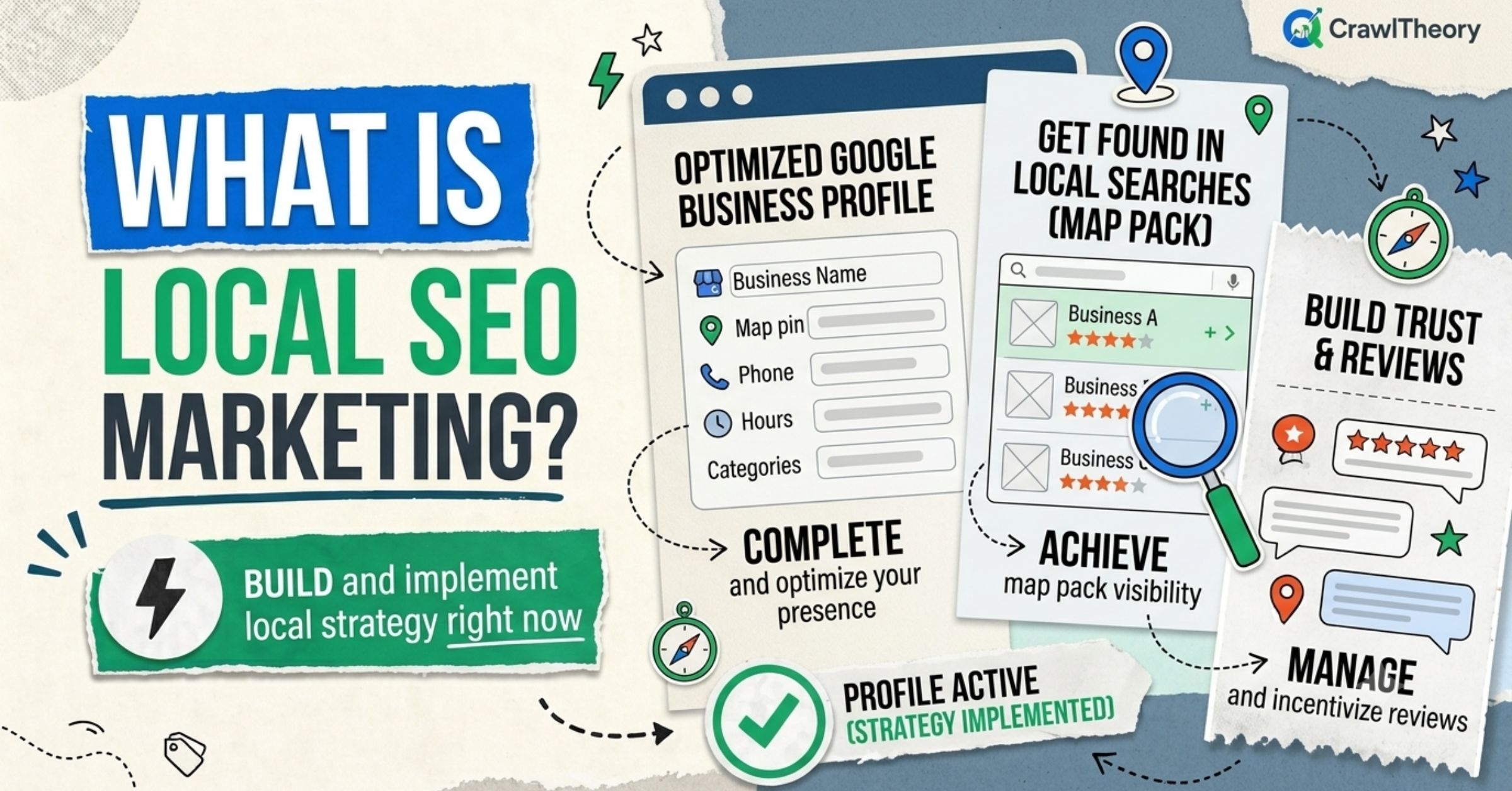
If you have ever searched ‘dentist near me’ on your phone and clicked the first result, you’ve experienced local SEO from the user’s side. But what’s actually happening on the business’s side? And why do some businesses show up while others equally good, maybe even better, don’t?
That’s what this guide answers. No fluff, no theory for theory’s sake. Just what local SEO marketing actually is, how it works inside Google, and what it takes to rank — from 5 years of doing this across 300+ businesses globally.
Local SEO Definition: What Does It Actually Mean?
Local SEO (Local Search Engine Optimization) is the practice of optimizing a business’s online presence, so it shows up when people search for nearby products or services.
Think of it this way:
- Someone searches ‘emergency plumber Chicago’ on Google.
- Google shows a map with three businesses at the top — that’s the Local Pack.
- Below that, organic listings appear. Both spots are influenced by local SEO.
Local SEO is not one single thing. It’s a system of signals — your Google Business Profile, your website, your reviews, your citations — all telling Google: this business is real, it’s here, and it’s the right fit for this searcher.
Local SEO = Optimizing your online presence to rank in location-based search results, so nearby customers find you when they’re actively looking for what you offer.
Local SEO vs. Internet Marketing vs. Regular SEO — What’s the Difference?
These terms get used all the time interchangeably — and it causes real confusion. Here’s how they actually relate:
| Type | Focus | Best For |
|---|---|---|
| Regular SEO | Ranking nationally/globally for keywords | E-commerce, SaaS, national brands |
| Local SEO | Ranking in a specific city, area, or neighbourhood | Restaurants, clinics, plumbers, salons, lawyers |
| Internet Marketing | Broad umbrella — includes SEO, PPC, social, email | Any business with an online presence |
| Local Search Engine Advertising | Paid ads (Google Ads, LSAs) targeted to a local area | Businesses wanting fast local visibility with a budget |
You cannot improve what you don’t measure. To track how many local directory clicks turn into website leads, consult our guide to GA4 for beginners to configure your local landing page tracking.
Local SEO is one lane of the broader internet marketing highway. And unlike paid local advertising — which stops the moment you stop spending — local SEO compounds over time.
What Is Google Local SEO? How the Ranking System Works
Google doesn’t use one algorithm — it uses different systems for different result types. For local searches, it runs a separate local algorithm that looks at three core factors:
1. Relevance
How closely does your business match what the person searched for? Your Google Business Profile category shapes this, your website content, and the keywords used in your reviews and business description.
2. Distance
How far is your business from the searcher? Or from the location they specified? You can’t fake proximity — but you can make sure Google knows exactly where you are.
3. Prominence
How well-known is your business online? This covers your reviews (quantity, rating, recency), backlinks from local sources, citations in directories, and overall brand mentions across the web.
Relevance is the most controllable factor. Businesses that clearly and specifically describe what they do — in their GBP, website, and service pages — outrank vague or generic competitors even when those competitors have more reviews.
Google shows local results in two places — the Local Pack (the map + three listings) and the standard organic results below. Different algorithms control these. A strong local SEO strategy targets both.
What Local SEO Actually Involves — The Core Components
Local SEO isn’t just “optimise your Google listing.” It has multiple interconnected parts. Here’s what the full picture looks like:
- Google Business Profile (GBP): Your GBP is the single most important local SEO asset. It’s the listing that appears in the map pack, on Google Maps, and in the knowledge panel when someone searches your brand. Keeping it accurate, complete, and active — with photos, posts, and responses to reviews — directly impacts your local pack rankings.
- NAP Consistency: NAP stands for Name, Address, Phone Number. Google cross-references your business details across the web. If your address is listed differently on Yelp, your website, and Google, that inconsistency weakens Google’s confidence in your business. Consistency across all directories signals that you’re legitimate and trustworthy.
- Local Citations: A citation is any online mention of your business’s NAP — on directories like Yelp, Justdial, Sulekha, or industry-specific platforms. They don’t pass link authority the way backlinks do, but they build the trust layer that local rankings depend on.
- On-Page Local SEO: Your website needs to clearly signal where you operate. This means location-specific pages (not just a contact page with an address), title tags and meta descriptions that include the city or area you serve, schema markup to tell search engines what you do and where, and fast mobile performance — because most local searches happen on phones.
- Reviews: 81% of consumers check Google reviews before visiting a local business (BrightLocal, 2024). More reviews, better ratings, and how you respond to them — all of these influence both your rankings and your click-through rate. Reviews are visible social proof and a ranking signal simultaneously.
- Local Link Building: Links from locally relevant websites — a local newspaper, a chamber of commerce, a neighbourhood blog — carry more weight for local SEO than generic backlinks. They tell Google you’re embedded in the community, not just a website that happens to list an address.
Mobile search behavior has changed how consumers find businesses on the go. A crucial subset of your local strategy involves optimizing specifically for proximity, so make sure you learn how to rank for near me searches.
Who Needs Local SEO in Digital Marketing?
Any business that depends on customers within a specific geographic area needs local SEO. That includes:
- Physical stores (retail, restaurants, salons, gyms)
- Service-area businesses (plumbers, electricians, pest control, home cleaning)
- Professional services (doctors, dentists, lawyers, accountants)
- Hospitality businesses (hotels, cafes, event venues)
- Multi-location chains that need to rank in each city
If your revenue depends on customers being physically close to you — or even just within a drivable distance — local SEO is not optional. It’s the foundation of your digital presence.
76% of people who search for something nearby on their phone visit a related business within 24 hours, and 28% of those searches result in a purchase (Think with Google). The intent behind local searches is among the highest of any traffic source. These are not browsers. These are buyers.
A Note on “Lokales SEO Marketing”
If you’ve come across the phrase “lokales SEO marketing,” this is simply the German-language equivalent of local SEO marketing. The concept, strategy, and execution are the same regardless of geography or language. Google’s local algorithm applies globally, and the principles of GBP optimization, local citations, and review management are consistent whether you’re running a business in Mumbai, Munich, or Melbourne.
The only real difference is the local directory ecosystem (Sulekha vs. Yelp vs. Das Örtliche) and the language in which you optimize your content. The underlying logic is identical.
What Local SEO Is Not
A few common misconceptions worth clearing up:
- It’s not just Google My Business. GBP is one component — important, yes, but not the whole game. Businesses that only optimize GBP and ignore their website or citations plateau quickly.
- It’s not a one-time setup. Local SEO is ongoing. Reviews need responses. Listings need updates. Content needs refreshing. The businesses that pull ahead are the ones that treat it as an active strategy, not a checklist.
- It’s not the same as local search engine advertising. Paid local ads (Google Ads, Local Services Ads) put you at the top immediately — but disappear when the budget does. Local SEO builds a presence that earns traffic without ongoing ad spend.
- It’s not slower than paid. It’s different. Some local markets see movement in 6–12 weeks. Highly competitive cities may take 4–6 months. But unlike PPC, the rankings you earn don’t evaporate the moment you stop.
Once you have a grasp of the basic concepts, the next step is building out a comprehensive process for execution. Read our full checklist on execution-level local search optimization to get started.
Quick Local SEO Marketing Questions
Local SEO means optimizing a business’s online presence — Google Business Profile, website, reviews, and directory listings — so it ranks when nearby customers search for relevant products or services.
Google local SEO refers specifically to ranking in Google’s local results: the Local Pack (map + 3 listings) and local organic results. Google’s local algorithm ranks businesses based on relevance, distance, and prominence.
Internet marketing is a broad umbrella that includes SEO, paid ads, social media, and email. Local SEO is a specific discipline within that — focused on earning visibility in location-based searches without paid advertising.
Local search engine advertising refers to paid placements in local search results — such as Google Ads or Local Services Ads (LSAs) — that appear above the organic and local pack results for a specific geographic area.
Yes. Local SEO targets customers who are already looking for what you offer, in your area, right now. The conversion intent is high, and the long-term return outperforms most paid channels once rankings are established.
In less competitive markets, you may see movement in 6–12 weeks. Competitive cities can take 4–6 months for meaningful ranking gains. Unlike paid ads, results compound and persist over time.
Lokales SEO marketing is the German term for local SEO marketing. The strategy is identical — optimizing a business’s online presence to rank in geographically relevant search results, using the same core principles regardless of language or country.
The Bottom Line
Local SEO marketing is how businesses that serve real people in real places get found by those people online. It’s not about gaming Google. It’s about making sure the information Google needs to trust and recommend your business is accurate, complete, and consistent everywhere it looks.
This introductory guide is just the first layer of geographic targeting. Read through our complete index of Local SEO guides to map out your full learning path.
From our experience working across 300+ websites: the businesses that grow consistently through local SEO are not the ones doing the most — they’re the ones doing the right things consistently. A fully optimized GBP, a website that answers local intent, and a steady stream of genuine reviews will outperform almost any complex strategy.
Start there. Build from there.