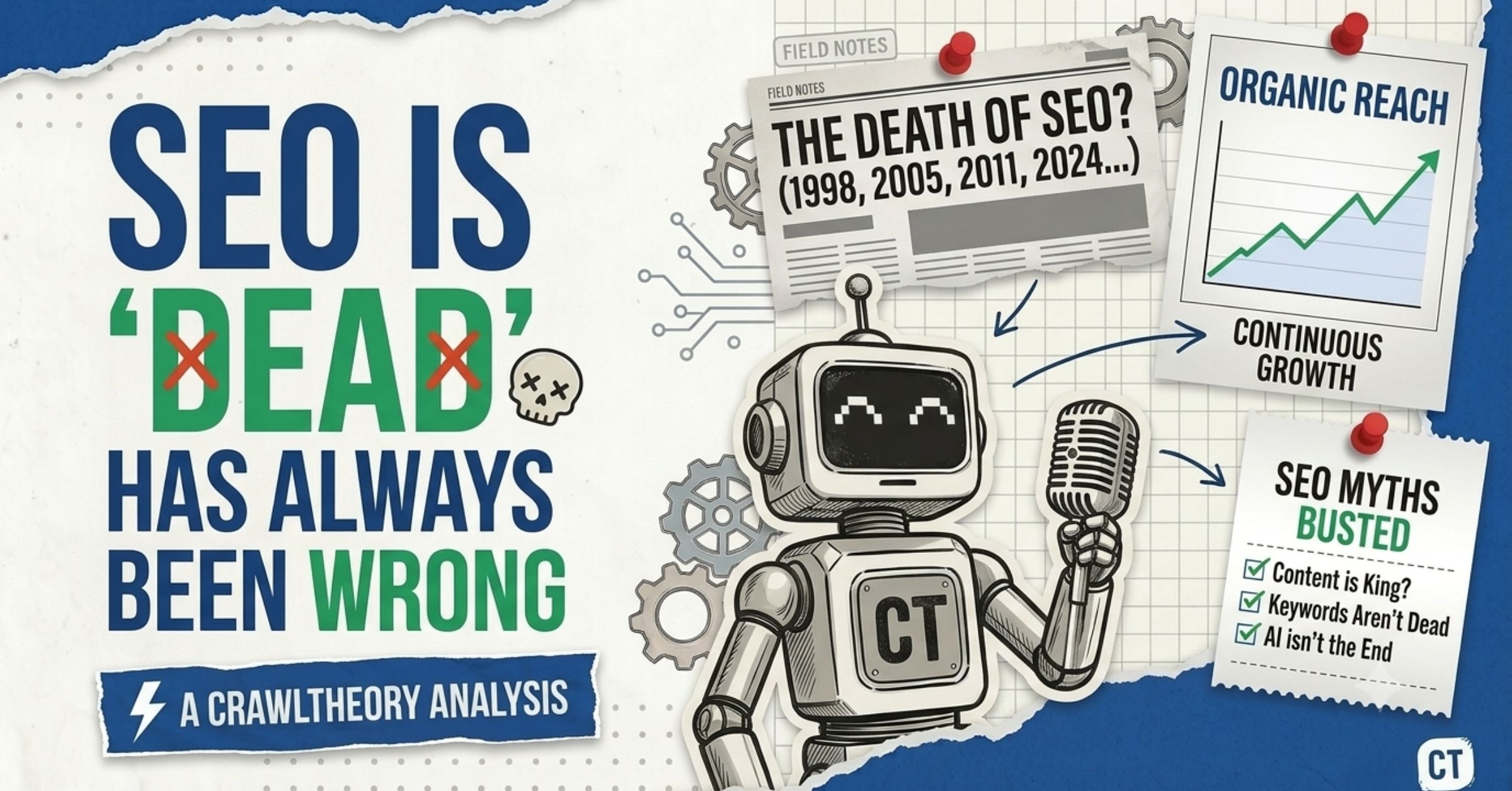
Quick answer: SEO has been declared dead at least once a decade since 1997 — the same year the term was coined. Every “death” lined up with a major shift in search (an algorithm update, a new platform, now AI) that killed a tactic, not the discipline. Today, SEO is an ~$86 billion industry, still growing in the double digits. What dies each cycle is the shortcut. What survives is the job underneath: being findable when someone is looking for what you offer.
If you remember one thing: “SEO is dead” is not an obituary — it’s a tell. It usually means someone’s old playbook stopped working. That is a very different thing from the work itself ending.
Why this keeps landing on your desk
Every few years, a confident headline announces the end of SEO. It feels credible each time because something real is changing. In 2026, it’s AI Overviews sitting above the organic results, ChatGPT swallowing queries that used to go to Google, and zero-click searches becoming the norm. The case sounds stronger than it ever has.
But this exact pattern — genuine disruption, premature funeral — has repeated for nearly three decades. Calling SEO dead because AI changed search is like calling real estate dead because Zillow exists. The medium changed. The demand to be found didn’t.
If you’re newer to the field, the panic is understandable: you’ve only lived through the current cycle. The point of this piece is to hand you the full arc — so you can tell the difference between a tactic dying and a discipline ending, and walk into that budget meeting with receipts.
The full SEO timeline (1991–2026)
Before SEO had a name (1991–1996): the wild web
The web went public in 1991. Early crawlers and directories — Archie, Excite, Lycos, AltaVista, and Yahoo! (launched 1994 as a human-edited directory) — existed just to help people find anything at all. Ranking was almost entirely on-page: meta keywords, keyword density, basic HTML. Webmasters quickly learned they could stuff keywords and spin up doorway pages to climb. Results were often a swamp of manipulation.
This is the era people romanticize as “easy SEO.” It was easy because the systems were primitive — and that ease is precisely what every later update spent years dismantling.
The first search engine, Archie, debuted in 1990 and didn’t even index web pages — there barely were any. It indexed file names on public FTP servers. The entire concept of “ranking a website” didn’t exist yet.
1997: the term is born — and so is the first “death”
The phrase “search engine optimization” surfaced around 1997, with pioneers like John Audette and Bruce Clay shaping it into a service. Here’s the part nobody tells you: the same year produced the first recorded “SEO is dead” claim, when marketer Richard Hoy reportedly called search a “dead-end technology.”
So the obituary is, almost to the month, as old as the name itself. Sit with that for a second — it reframes every “death” headline you’ll ever read.
1998–2002: Google and PageRank change the game
Larry Page and Sergey Brin’s PageRank used links as votes of authority — a clean break from pure on-page gaming. Plenty of technologists assumed algorithms would soon get so good that optimization would become pointless. Instead, a whole new frontier opened: link building. (Which, predictably, spawned link farms and reciprocal-link schemes — the thing Google would spend the next decade unwinding. More on how earning links works now in our link building guide.)
2003 — Florida: the first mass extinction event
Google’s “Florida” update (November 2003) wrecked sites built on keyword stuffing and crude manipulation, often overnight. WebmasterWorld forums filled with panic; businesses watched rankings and revenue collapse right before the holiday shopping season. “Google destroyed the industry” was the cry.
What actually happened: SEO professionalized. Florida was Google’s first unmistakable message that manipulation doesn’t scale. The work didn’t end — the shortcuts did.
Notice the recurring shape: a tactic that worked because the algorithm couldn’t yet detect it stops working the moment the algorithm catches up. If a tactic’s only advantage is that it hasn’t been caught yet, it has an expiry date. Build on things that work because they’re good, not because they’re undetected.
2005 — the “ShoeMoney” declaration
Entrepreneur Jeremy “ShoeMoney” Schoemaker published a widely shared post declaring SEO over, arguing search engines were improving so fast that any top ranking would inevitably be corrected. Search got smarter. SEO got smarter alongside it. The people who adapted kept their rankings; the people who quit handed those rankings to the people who adapted.
2009–2010 — Caffeine, and “social will replace search”
Google’s Caffeine update (2010) rebuilt the indexing system for fresher, faster results. At the same time, with Facebook and Twitter exploding, influencers predicted social feeds would replace search — people would be fed content, not look for it. Wired ran with the theme. Search didn’t die. Social became an additional channel, not a replacement — the same thing AI is becoming now.
2011 — Panda: the content-quality reckoning
On February 24, 2011, Google launched what became known as Panda, targeting thin, low-value, ad-heavy content and content farms. Forbes ran “SEO Is Dead.”
This one rewrote the rules. Here’s the aftermath data worth bringing to a meeting:
Facts & figures — Panda aftermath
- Panda noticeably affected 11.8% of all U.S. English queries on launch — one of the largest single hits in search history (Google, via Wired).
- It was named internally after engineer Navneet Panda, who cracked the core breakthrough — not after the animal.
- The kicker: for most sites that got hit, the damage was permanent. In one analysis of 22 affected sites, none had recovered their pre-Panda visibility two years later — unless they fundamentally changed their content strategy.
Content mills that had gamed the system genuinely died. Sites that invested in actually useful content rose. The lesson — quality over volume — still anchors SEO today. (Many of the “myths” we still see wasting budgets are leftovers from the pre-Panda era.)
2012 — Penguin (and Venice): the link reckoning
On April 24, 2012, Penguin went after manipulative link building — link farms, paid links, and over-optimized anchor text. Matt Cutts, then head of Google’s webspam team, announced it as “another step to reward high-quality sites.” Venice (February 2012) localized results, an early ancestor of today’s local SEO.
Facts & figures — Penguin aftermath
- Penguin's first launch hit roughly 3.1% of English queries (Matt Cutts).
- The recovery timeline was brutal: because early Penguin only refreshed periodically, a penalized site could wait 6 months to 2 years to recover — even after cleaning up its links.
- From Penguin 4.0 (2016) onward it became real-time and part of the core algorithm, so devaluation and recovery now happen continuously.
Manipulative link tactics collapsed. Earned authority and relevance became the path — and stayed the path.
The single most expensive SEO mistake of this whole era was buying links to “get ahead faster.” Every link-buying boom has ended with a Penguin-style correction. If a 2026 vendor promises you 500 backlinks for a flat fee, you are buying a future penalty, not a shortcut.
2013 — Hummingbird: the meaning era begins
Hummingbird (announced September 2013) was a full engine overhaul, not a bolt-on. It introduced semantic search — understanding the intent and context behind a query, not just matching keywords. This is the moment SEO shifted from “rank for a keyword” to “satisfy the why behind the search.” That principle has only deepened, and it’s the direct ancestor of how AI engines read your content today.
2014–2015 — Mobilegeddon and RankBrain
The April 2015 Mobile-Friendly update (“Mobilegeddon”) made mobile usability a ranking factor — Google pre-announced it two months early so developers could prepare. Then, RankBrain (October 2015) brought machine learning directly into ranking. The predictable headline followed: “AI will replace SEO.” Instead, optimizers learned to write for intent and topic coverage instead of exact-match phrases.
Google confirmed RankBrain had quietly been running since spring 2015, before the October announcement — initially on the ~15% of queries Google had never seen before. By 2016, it had touched essentially every query. The “AI is taking over search” headline you’re reading in 2026 was first written, almost word for word, in 2015.
2018–2019 — Medic (E-E-A-T) and BERT
The August 2018 “Medic” update elevated expertise, authority, and trust — what we now call E-E-A-T — hitting health and finance sites hardest. Then BERT (October 2019) gave Google a far better grasp of natural language and context. Pandu Nayak, Google’s VP of Search, called it “the biggest leap forward in the past five years.”
The throughline: credibility and genuinely understanding language matter more; keyword tricks matter less. If that sounds exactly like what AI search rewards in 2026 — it is. This curve has been bending in the same direction for a decade.
2021–2022 — Page Experience, MUM, and the Helpful Content Update
Core Web Vitals became part of the Page Experience signal (2021). Then, on August 25, 2022, the Helpful Content Update introduced a site-wide machine-learning classifier that penalized content “written for search engines rather than humans.” A second rollout that December went global. Cue: “Google is done with SEO content.” What it was actually done with: content produced only to rank, with zero value to a reader. (The SEO mistakes that still get sites flagged mostly trace back to this classifier.)
2023–2026 — AI Overviews, AI Mode, and the GEO era
Google’s Search Generative Experience (2023) became AI Overviews (2024), and AI Mode debuted in 2025. ChatGPT Search, Perplexity, Claude, and Gemini began pulling real query volume away from traditional search. Between 2022 and early 2026, Google shipped roughly 30+ confirmed updates — an unprecedented cadence. (We track the live ones in the news desk, and broke down everything from Google I/O 2026 here.)
This is the current “SEO is dead” cycle. And like every one before it, it’s pointing at something real.
What’s actually different this time (because something always is)
Being honest about this is what makes the rebuttal credible. The AI shift is bigger and faster than past disruptions, and the data backs that up:
- Zero-click is now the default. Depending on the dataset, roughly 58–65% of U.S. Google searches end without a click — a trend Rand Fishkin’s SparkToro first quantified at ~50% back in 2019, so it predates AI. With an AI Overview present, the zero-click rate jumps to about 83%; in Google’s AI Mode it reaches roughly 93%.
- AI Overviews are everywhere and growing. They now appear on a large and rising share of searches and reach well over a billion users monthly. They show up most on long, question-style queries — the exact queries informational content used to win clicks on.
- AI search has gone mainstream. Hundreds of millions of people use ChatGPT and similar tools daily for things they’d once have Googled.
- But — and this is the line for your budget meeting — traditional search still sends vastly more referral traffic than all AI tools combined, and visitors who do arrive from AI platforms convert at multiples of traditional organic visitors. Fewer clicks, dramatically higher intent.
So yes: if your entire strategy was “rank #1 and harvest the click on informational queries,” that strategy is under genuine pressure. That’s the tactic dying — exactly as in 2003, 2011, and 2012. The discipline is doing what it always does: moving up a level.
The real risk in 2026 isn’t that “SEO stops working.” It’s that you keep measuring SEO only by clicks while the value quietly moves to citations and visibility inside AI answers. If your reporting can’t see AI referrals or AI-answer mentions, you’ll conclude SEO is dying when it’s actually relocating. Set up AI-referral tracking in GA4 before you cut a single rupee or dollar of budget.
The pattern, made explicit
Lay the cycles side by side, and the shape is impossible to miss:
| Year | The trigger | What died | What survived |
|---|---|---|---|
| 1997 | Term coined | ”Search is a fad” | The need to be found |
| 2003 | Florida | Keyword stuffing, doorway pages | Professional, durable SEO |
| 2005 | Smarter engines | Quick-win ranking hacks | Sustainable optimization |
| 2010 | Social media boom | ”The open web is over” | Search as a core channel |
| 2011 | Panda | Content farms, thin pages | Genuinely useful content |
| 2012 | Penguin | Link farms, paid links | Earned authority |
| 2015 | RankBrain | Exact-match keyword obsession | Intent-based content |
| 2019 | BERT | Robotic keyword-first writing | Natural language that serves intent |
| 2022 | Helpful Content | Content built only to rank | Content built for people |
| 2024–26 | AI Overviews | Click-harvesting on info queries | Authority, citation, trust |
Every time SEO has been declared dead, it wasn’t the end of optimization. It was the end of shortcuts.
What SEO actually becomes in the AI era
The discipline isn’t shrinking; its surface area is expanding. The new frontier is being the source AI systems cite, not just the link a user clicks. Some call it Generative Engine Optimization (GEO) or Answer Engine Optimization. Strip the jargon, and it rewards the same things good SEO always has — just more strictly:
- Original research, data, and statistics. Content with citable numbers gets cited. AI quotes sources that say something quotable.
- Genuine expertise and trust signals. E-E-A-T isn’t a checkbox anymore; it’s increasingly the filter for whether you’re cited at all.
- Clean, extractable structure. Clear answers, FAQ formatting, logical hierarchy — so models can lift your content accurately. (Our full on-page checklist covers this.)
- Brand authority in a specific topic. AI engines favor recognizable, trusted specialists over generalists chasing volume.
- The unglamorous technical foundation. Crawlability, speed, structured data, mobile usability — AI systems draw from the same web index, so none of it stopped mattering.
Notice that none of this is new in spirit. It’s the 2013 Hummingbird lesson (serve intent), the 2011 Panda lesson (be useful), and the 2018 Medic lesson (be credible) — now enforced by stricter judges.
A 2024 Princeton/IIT Delhi study tested 10,000 queries and found that adding citations, quotations, and statistics to content boosted how often AI engines cited it by over 40%. The “new” GEO playbook is, mechanically, just good editorial standards — the kind journalists have used for a century.
A field note: what this looked like across 300+ sites
I’ve watched this play out personally, not just in headlines. After the Helpful Content Update, an e-commerce client of ours lost about a third of their organic traffic almost overnight — they’d leaned on hundreds of thin, near-duplicate category descriptions written purely to target keyword variations. The panic in that first meeting was exactly the “SEO is dead” energy you’re probably feeling pressure from now.
We didn’t chase a loophole. We consolidated those thin pages into fewer, genuinely useful ones — real buying guidance, honest comparisons, specifics only someone who’d handled the products would know. It took about five months. Not only did organic recover past its previous peak, but by mid-2025, those same consolidated pages were the ones getting cited in AI Overviews and Perplexity for their category. The work that survived the “death” was the same work that won the next era. That’s the whole pattern in one client.
It’s the same lesson from a totally different angle: a local services client we rebuilt around their Google Business Profile and real, near-me-intent content started getting recommended by ChatGPT for their city within a year — because they’d built genuine local authority, not despite the AI shift.
How to read the next “SEO is dead” headline
You will see this headline again — probably within months. When you do, ask three questions:
- What tactic is actually dying? There’s almost always a specific, nameable shortcut losing value. That part is usually true, and worth acting on.
- Who benefits from you believing it’s over? Sometimes it’s people selling “the next thing.” Sometimes it’s competitors who’d love for you to give up the rankings.
- Has the underlying demand changed? People still need to find products, answers, and services. As long as that’s true, the work of being findable has a future.
The practitioners who win each cycle aren’t the ones who declared SEO dead, and they aren’t the ones who ignored the shift. They’re the ones who let the old tactic die on time and built around the new reality early.
More Questions on “SEO Is Dead”
Is SEO dead in 2026?
No. SEO has been declared dead repeatedly since 1997 and is now an ~$86 billion industry growing at double-digit rates. What changes each cycle is which tactics work — keyword stuffing, link farms, and content mills all genuinely died — while the core discipline of being findable when people search keeps growing. The 2026 AI shift is real, but it relocates SEO’s value toward AI citations and visibility rather than ending it.
Why do people keep saying SEO is dead?
The phrase resurfaces after every major change in how search works — an algorithm update or a new platform — because each shift kills the previous era’s tactics. People mistake the death of a tactic for the death of the discipline. It has happened in 1997, 2003, 2005, 2010, 2011, 2012, 2015, 2022, and again with AI in 2024–2026.
When did SEO start?
The practice began in the mid-1990s as webmasters optimized meta tags and keywords, but the term “search engine optimization” was coined around 1997. Google’s 1998 launch and PageRank reshaped the field, and every major algorithm update since has refined what “optimization” means.
Did AI Overviews kill SEO?
No, but they changed the scoreboard. AI Overviews raised zero-click rates sharply (to ~83% on queries where they appear), which reduces clicks on informational content. The response is to optimize for being cited inside AI answers — strong structure, original data, and topical authority — while traditional search still drives the majority of referral traffic.
Should I still invest in SEO in 2026?
For most businesses, yes — but measured correctly. Track AI referrals and AI-answer visibility alongside traditional rankings, because the value is shifting toward citations. Visitors arriving from AI platforms convert at several times the rate of traditional organic traffic, so even smaller volumes can deliver outsized results.
The bottom line
SEO has been buried in 1997, 2003, 2005, 2010, 2011, 2012, 2015, 2022, and again in 2026. By any measure, it’s the healthiest corpse in marketing. Each “death” was a real inflection point that ended a way of gaming search — and each time, the discipline came back larger, more professional, and more tightly aligned with actually helping the person doing the searching.
The version of SEO that worked two years ago is not the version that works today. That has always been true. Adapt to it, and “SEO is dead” stops sounding like a warning and starts sounding like what it’s always been: the noise of a shortcut closing — and an opening for the people paying attention.
So when that LinkedIn post hits your inbox, you don’t have to argue about whether SEO is dead. You can point at 29 years of identical headlines, every one of them wrong in the same way, and ask the only question that matters: what’s the new work, and are we doing it?
Want the practical next step? Start with our most common SEO questions answered in plain English, then browse the full resource library.
Written by Yash — Co-Founder, The Crawl Theory. Five years of SEO across 300+ websites in e-commerce, SaaS, local, and media, in markets across Asia, North America, and beyond. I write about what I’ve actually tested — not what sounds right in theory.