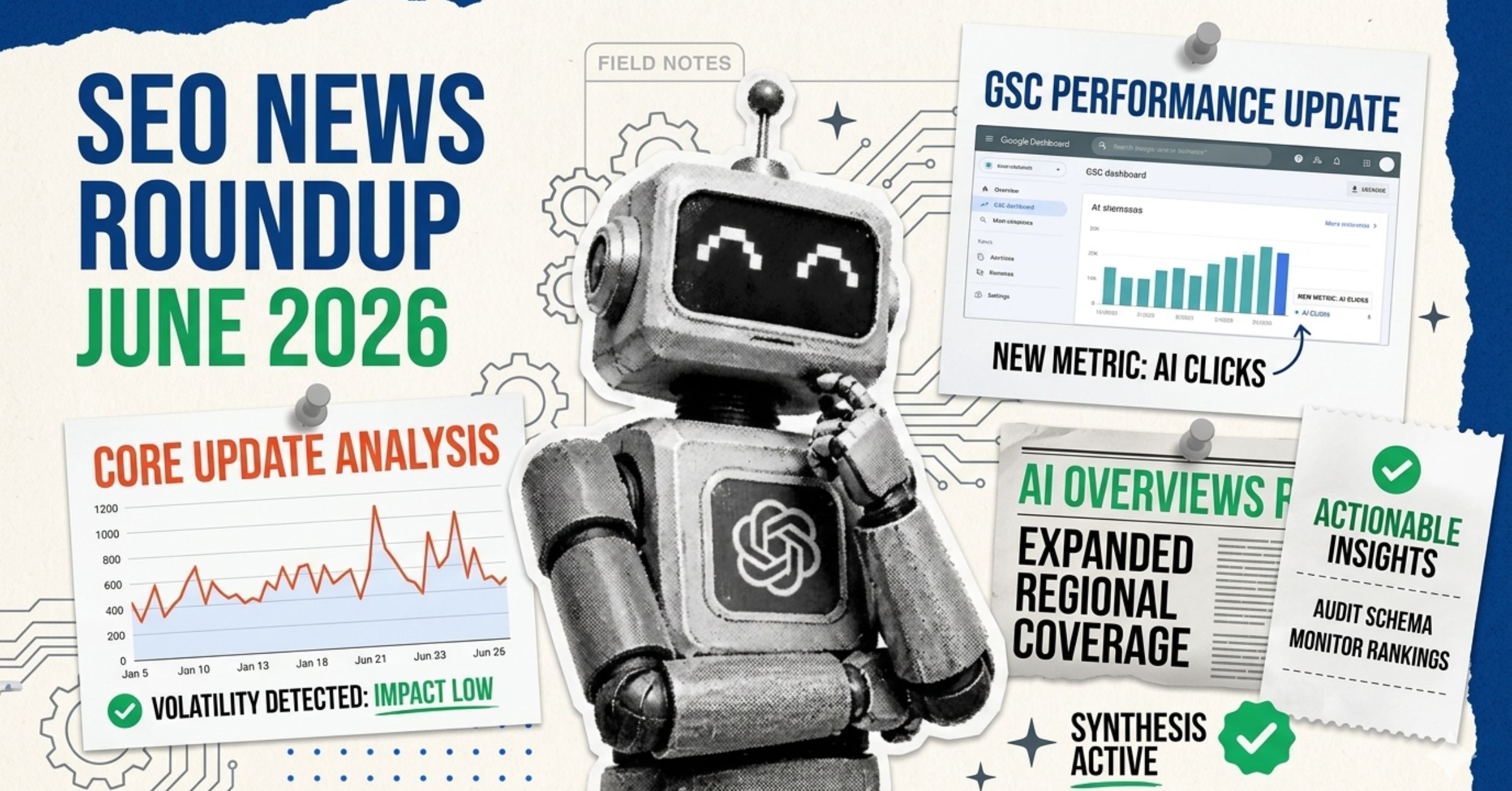
The first half of June 2026 handed SEO practitioners one of the busiest news cycles of the year. The May core update finished rolling out, fresh data showed Reddit climbing in every niche tracked, and Google published guidance that quietly positions itself as the final word on SEO, AEO, and GEO. Add new zero-click numbers, Google Business Profile data landing in both Analytics and Gemini, and Search profiles for creators, and the through-line is hard to miss: search work keeps shifting onto the big platforms.
This roundup pulls the week’s most consequential stories into one place, with the figures, the named sources, and — because I’ve spent the last five years working across 300+ websites globally — the practical “so what” for your own sites. Let’s get into it.
Reddit Climbed in Every Niche After the May Core Update
The headline data point this cycle comes from an SE Ranking analysis of 100,000 keywords. After Google’s May core update, Reddit grew its top-3 presence across all 20 niches the platform tracks.
A few numbers stand out:
- Reddit’s overall top-3 share rose to 10.24% after May, up from 8.56% after March and 9.19% after December.
- Reddit held the #1 position for 13,872 keywords after May — a 54% jump from 8,993 in March.
- The biggest gains landed in experience-led niches: Pets (+3.18 points to 18.05%), Education (+3.03), Sports & Exercise (+3.02), and E-commerce & Retail (+2.61).
- YMYL niches barely moved. Healthcare crept from 0.93% to just 1.33%.
Reddit’s gains essentially reversed what happened after the March update, when an Amsive analysis found Reddit and similar user-generated platforms losing visibility while brand sites gained. The same platform moved in opposite directions across two consecutive updates — a strong argument against drawing big conclusions from any single rollout.
There’s a sobering recovery stat buried in the same dataset: only 32.2% of domains that lost top-10 positions after March made it back after May. The other two-thirds are still waiting. If you’re sitting on a March loss hoping the next update fixes it, the data says don’t count on it — diagnose and fix instead.
What This Means For You
The niche-level split is the real story. “Reddit is taking over the SERPs” reads very differently if you’re in pets (18% of the top 3) versus healthcare (1.33%). For experience-driven queries, you’re now competing with a forum thread that Google reads as lived experience. The practical response isn’t to fight Reddit head-on — it’s to inject genuine first-hand experience, original data, and specifics into your own pages. That’s the heart of answer engine optimization best practices, and it’s also a smart reminder to participate authentically where your audience already gathers.
Run a quick top-3 audit of your money keywords. Note every query where Reddit, Quora, or a forum now sits above you. Those are your “experience gap” pages — the ones that need a real case study, original screenshots, or a named expert quote far more than another round of keyword tweaks. A disciplined approach to SEO keyword tracking makes this audit a 20-minute job rather than a guessing game.
The May Core Update Rewarded Intent and Market Fit — Not Raw Authority
Independent SEO consultant Aleyda Solis analyzed SISTRIX visibility data from the U.S. and UK between May 26 and June 2, the day Google confirmed the rollout was complete. Her finding cuts against a common assumption: authority alone didn’t decide the winners.
Instead, pages that best fit a query’s intent, market, and result type gained, while sites one step removed from that fit lost ground. The evidence:
| Signal | What Happened | Example |
|---|---|---|
| Original vs. third-party source | Original sources gained, intermediaries dipped | cambridge.org +40.9%; pronunciation tool youglish.com −69.6% (UK) |
| Local vs. global market fit | Local domains won in the UK | amazon.co.uk +21.3%; amazon.com −54.6% for UK users |
| High authority, wrong fit | Strong domains still dropped | nytimes.com and nih.gov both lost visibility |
Even Reddit fits the nuance here: reddit.com fell 23.8% in the UK index in Solis’s data, while SE Ranking’s largely U.S.-based dataset showed gains. The lesson is that no whole category “won” or “lost.” Marketplaces like trip.com and indeed.com gained; some forums pulled back. Fit beat label.
If you run international sites, the UK data is a warning. Global .com domains lost heavily to local versions for local users. Check whether your pages are ranking in the wrong market and whether your country-specific signals (hreflang, local entities, currency, local links) are strong enough. A .com page outranking your .co.uk page for UK users is now a measurable liability.
What This Means For You
For every important query, identify which result type gained after the update, then confirm your page is that type, not a weaker echo of a source that already owns the intent. This is exactly why chasing volume without matching intent remains one of the most expensive SEO mistakes to avoid. Google’s own core update documentation recommends waiting at least a week after completion before reading Search Console data, which puts the earliest clean read around June 9 — so treat early tool data as a signal, not a verdict.
Different visibility tools measure the same update differently and can rank the same domains in opposite directions. SE Ranking (U.S. clickstream-style keyword set) and SISTRIX (visibility index) produced genuinely different pictures of Reddit in the same month. Always note which tool and which market a “winners and losers” report is based on before you act on it.
SparkToro: 68% of Google Searches Now End Without a Click
SparkToro co-founder Rand Fishkin published new U.S. zero-click data drawn from Similarweb’s clickstream panel, covering January through April 2026. The numbers are blunt:
- 68% of Google searches ended without a click.
- For every 1,000 searches, just 232 clicks reached the open web.
- Of all clicks, 66% went to the open web, 27% to Alphabet’s own properties, and 6% to ads.
This lands right as Google’s new AI performance reports in Search Console begin showing impressions from AI Overviews and AI Mode — but not clicks. As Whitespark founder Darren Shaw put it in response to Fishkin’s data, people complaining that the new reports lack click data are missing the point: in an AI-answer world, impressions may be much of what you get.
If your reporting still treats last-click sessions as the primary success metric, you are now measuring a shrinking slice of reality. When two-thirds of searches never produce a click, “traffic down” can coexist with “visibility up.” Brief your stakeholders before the next quarterly review, not during it.
What This Means For You
The measurement shift matters as much as the traffic shift. Visibility tracking now means watching where you appear, not only what arrives in your analytics. A few practical moves:
- Pair impression data from Google Search Console with your session data to separate “we lost rankings” from “we ranked, but the answer was shown on the SERP.”
- Lean into being the cited source inside AI answers — the structured, quotable, genuinely useful content that earns a mention even when it doesn’t earn a click. Our guide on how to get your website listed in AI search results breaks down the inputs that feed those citations.
- Make sure your GA4 house is in order so you can actually read engaged sessions and conversions cleanly. If that’s shaky, start with GA4 for beginners.
Google Now Claims Authority Over SEO Tools, AEO, and GEO
In a move with long-term consequences, Google published a new Search Central page covering third-party SEO tools, services, and advice, and updated its long-standing “Do you need an SEO?” page with roughly seven changes.
The substance, as analyzed by SEJ’s Roger Montti:
- Google advises businesses to check SEO advice — explicitly including AEO and GEO — against Google’s own documentation, framing its docs as the “ground truth.”
- The updated hiring guidance warns about third-party tools and mentions AEO and GEO services by name.
- For the first time, the page encourages business owners to contact the FTC about fraudulent SEO services.
Two things are happening at once. Google is splitting the world into “third-party opinion” versus “Google’s documentation,” and it’s putting the official AEO/GEO terminology debate on the record. When a client asks whether they need a separate AEO strategy, Google’s answer is now formally written down.
This guidance is aimed squarely at agencies and anyone selling SEO services — which means clients will increasingly weigh your recommendations, and your tools, against Google’s docs. Get ahead of it: cite primary Google documentation in your deliverables and be transparent about where a tactic comes from. Vague promises and “secret” tactics will age badly against a page that tells business owners to call the FTC.
What This Means For You
This is good news for honest practitioners and bad news for hype merchants. Grounding your work in primary sources, plain explanations, and verifiable results is now a competitive advantage, not just good ethics. It’s also a timely nudge to clean house on the SEO myths that are wasting your money — the era of selling mystery is closing fast.
Add a short “Sources” or “Based on Google’s guidance” note to client reports, linking the relevant Search Central pages. It builds trust, pre-empts the “but Google says…” objection, and quietly demonstrates the experience and trustworthiness that EEAT rewards.
Google Business Profile Data Lands in GA4 and Gemini
Two updates put Google Business Profile (GBP) data in new places — a meaningful win for local SEOs who’ve spent years stitching reports together by hand.
In Google Analytics: Google documented a native Business Profile link that brings seven GBP metrics into GA4 reports, including calls, direction requests, and bookings. As Darren Shaw noted, local reporting has always been messy — website data in one place, GBP data in another. This closes part of that gap.
In the Gemini app: Once connected, Gemini can draft review replies, edit your profile, and answer performance questions. The Gemini features begin rolling out this month, with the Business Profile connection following in the coming weeks.
There’s a real limitation. GA4 combines metrics across linked profiles, so multi-location reporting still needs the GBP dashboard or the API. And as one practitioner flagged, profiles held inside a manager-account group currently can’t be connected — you have to ungroup them first. Don’t promise clients seamless multi-location dashboards until you’ve tested your exact setup.
What This Means For You
If you do local work, this is the cleanest path yet to a single view of how your profile drives calls and visits. But the value depends entirely on your account structure. Start by getting the fundamentals right with Google Business Profile for beginners, and tie the new GA4 metrics back to a coherent local search optimization strategy. For service businesses, this is especially powerful when paired with your plan to rank for “near me” searches, since calls and direction requests are the conversions that actually matter there. New to the discipline entirely? Our primer on what local SEO marketing is sets the foundation.
Google Launches Search Profiles for Creators
Google also rolled out Search profiles, giving eligible creators a customizable page within Search to showcase their articles, social posts, and follower count. At launch, the feature is U.S.-only and aimed at creators with around 100,000 followers.
For practitioners and brands building author authority, this is a signal worth tracking. Google is building more surfaces where a recognizable creator identity — not just a domain — earns visibility. It dovetails with the broader EEAT push toward demonstrable expertise tied to real, identifiable people.
What This Means For You
Even if you’re nowhere near the eligibility threshold, the direction is clear: invest in author entities. Consistent bylines, complete author bios, linked profiles, and a verifiable track record increasingly matter for both classic ranking and AI citations. Building that reputation now is what positions you to benefit when surfaces like this expand.
Mueller’s Unexpected Take on Folder Structure
Finally, a practical clarification that will settle a few internal debates. Responding to a question on Reddit about whether a U.S.-based international site needs duplicate /en-us/ folders for its home market, Google’s John Mueller was refreshingly blunt:
Using
/en-us/blog/instead of/blog/for U.S. content “likely isn’t going to make or break your site.” The real advantage, he said, is that it’s easier to filter and slice your metrics by country and language — not any practical SEO difference.
Notably, Mueller’s answer focused on analytics, not keywords or topical themes in the folder names. For a community that obsesses over keyword-rich URL paths, that emphasis is itself the takeaway.
Mueller explicitly said he wouldn’t expect an SEO difference between /blog/ and /en-us/blog/ in this scenario. The duplicate-content fear that drives many URL-structure debates was, in his framing, less important than whether your reporting stays clean. (See — analytics is the connective tissue of this entire roundup.)
What This Means For You
Choose URL structure for operational clarity and clean measurement, not for imaginary keyword juice in the path. If consistent /LL-CC/ folders make your country/language reporting trivial to segment, that’s a perfectly good reason to use them. Just handle duplicate content properly with canonicals and hreflang. For the broader picture of what actually moves the needle on a page, work from a proven on-page SEO checklist rather than folk wisdom about folder names.
The Theme Tying It All Together
Step back, and one pattern runs through every story: the search workflow is consolidating onto large platforms. Reddit collects top positions across niches. Two-thirds of searches resolve without leaving Google. Local data, tools, and management move into GA4 and Gemini. Google’s own documentation positions itself as the arbiter of what’s true. The data, the reporting, the tools, and even the advice all sit closer to the big platforms than they did a month ago.
For practitioners, the response isn’t panic — it’s adaptation. Track visibility, not just clicks. Build genuine experience and author authority that both Google and AI engines can verify. Ground your strategy in primary sources. And keep your measurement clean so you can tell the difference between a real loss and a SERP that simply answered the question for you.
If you want to spot the next shift before it shows up in your traffic, our running coverage of Google updates and the full Crawl Theory resource library are built for exactly that. You can also pressure-test demand and seasonality for any of these trends using Google Trends for SEO.
Questions We Get
Did Reddit really gain rankings in every niche after the May 2026 core update?
In SE Ranking’s analysis of 100,000 U.S. keywords, yes — Reddit grew its top-3 share across all 20 tracked niches and ranked #1 for 54% more keywords than in March. However, SISTRIX data showed reddit.com falling 23.8% in the UK, so the gains were market-dependent rather than universal.
What percentage of Google searches end without a click in 2026?
Per SparkToro’s January–April 2026 data from Similarweb’s clickstream panel, 68% of U.S. Google searches ended without a click. Only about 232 of every 1,000 searches sent a click to the open web.
Does Google have official guidance on AEO and GEO now?
Yes. Google’s updated Search Central guidance explicitly references AEO and GEO and advises businesses to check such advice against Google’s own documentation, which it frames as the authoritative reference.
Is Google Business Profile data available in Google Analytics?
Google has documented a native link bringing seven Business Profile metrics — including calls, directions, and bookings — into GA4. Multi-location reporting, though, still requires the Business Profile dashboard or API, and grouped manager-account profiles must be ungrouped before connecting.
Does URL folder structure like /en-us/blog/ affect SEO?
According to John Mueller, no meaningful SEO difference exists between /blog/ and /en-us/blog/ in a standard international setup. The practical benefit of localized folders is cleaner analytics segmentation by country and language, not ranking power.
Should I change my SEO strategy because of the May core update?
Don’t react to a single update. Wait at least a week after completion for clean Search Console data, then identify which result type each key query now favors and make sure your page is the best version of that type — original, intent-matched, and market-appropriate.
Reporting in this roundup draws on coverage and data from Search Engine Journal, SE Ranking, SparkToro/Similarweb, SISTRIX, and public statements from Aleyda Solis, Rand Fishkin, Darren Shaw, and Google’s John Mueller. Crawl Theory is an independent SEO resource center built on hands-on work across 300+ websites worldwide.