Most websites are not losing rankings because SEO is “too competitive.” They are losing because of quiet, compounding mistakes that compound over months and never get fixed. This guide covers the most damaging SEO mistakes still happening in 2026, with clear explanations and practical fixes drawn from five years of work across 300+ websites globally.
What Are the Biggest SEO Mistakes in 2026?
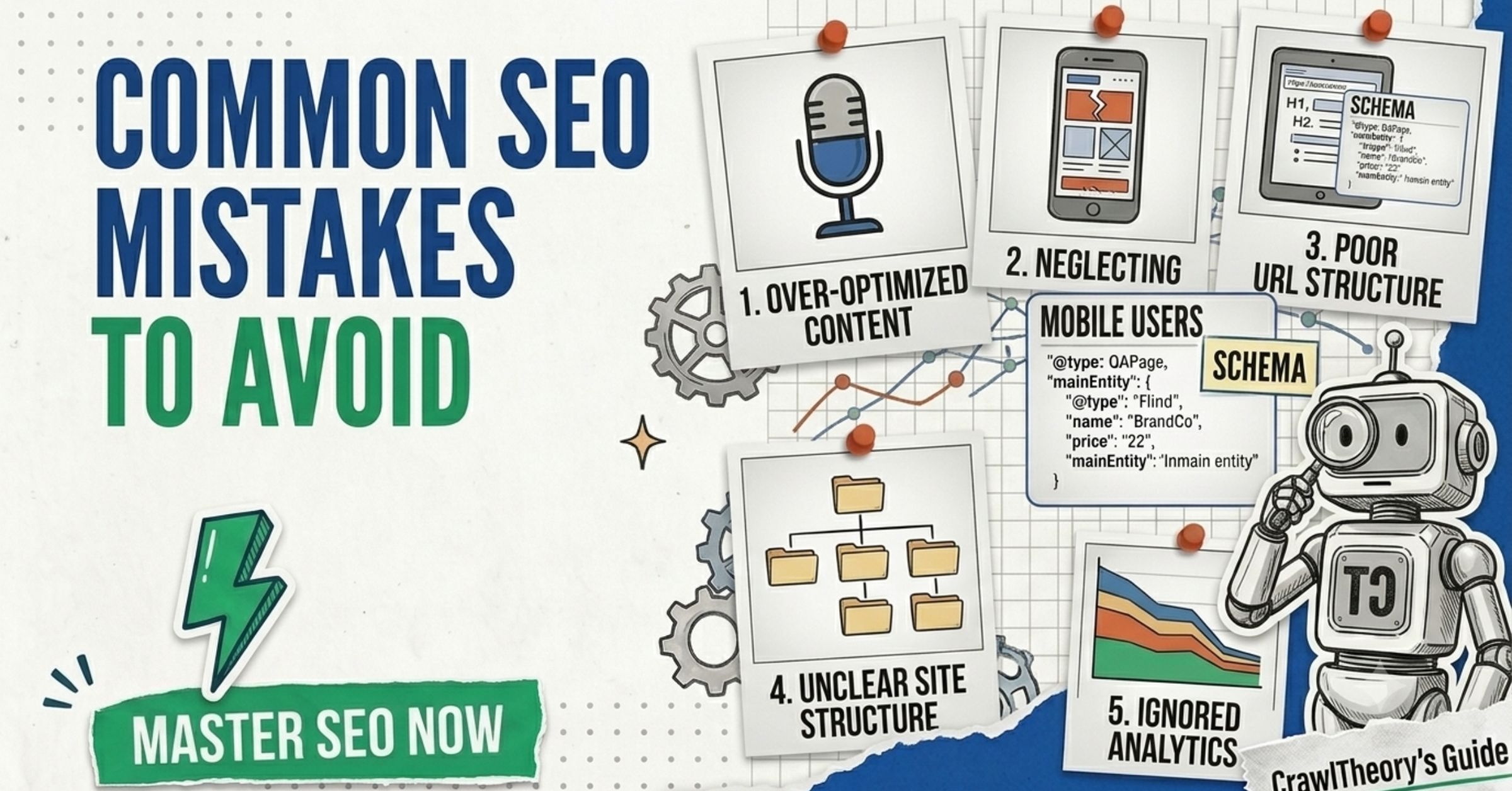
The biggest SEO mistakes in 2026 are: writing for keywords over people, ignoring search intent, skipping technical basics, publishing thin or outdated content, neglecting local SEO, and measuring the wrong metrics.
SEO in 2026 is not harder than it used to be. It is different. Google’s systems have become significantly better at separating genuinely useful content from content that only looks useful. AI-powered search platforms like Google AI Overviews and Perplexity now surface answers, not just links — which means old tricks that once moved rankings no longer work, and some actively backfire.
The good news: most ranking problems are fixable. In five years of working across 300+ websites — from solo local businesses to law firms, SaaS companies, and e-commerce stores — the same cluster of mistakes shows up again and again. Fix these, and results follow.
Let’s go through each one, clearly.
Mistake #1: Writing for Keywords, Not for People
What does “writing for keywords” actually mean — and why does it hurt?
Writing for keywords means creating content around search terms instead of around what a real user actually needs to know. The page looks optimized on the surface — keywords in headings, dense usage throughout — but it does not actually answer the question well.
Google’s helpful content systems are built to detect exactly this. In 2026, with AI-assisted ranking evaluation now mainstream, the signal of whether content is genuinely useful matters more than keyword frequency.
Here is what keyword-first writing looks like in practice:
- An article titled “Best SEO Tools 2026” that lists 30 tools with no context on which situation each tool is for
- A service page stuffed with “best plumber in [city]” five times in one paragraph
- A blog post that answers a question in the first 100 words and then pads out 2,000 more words of filler to hit a word count
The fix: Start with what the user is actually trying to accomplish. Then write to satisfy that need completely. Keywords belong in the page naturally — in the title, the first paragraph, the main headings — but they should not drive the structure.
If you are unsure what users actually need, look at Google Search Console query data. The search queries showing up for your pages tell you what people are actually typing — and whether your content is answering those specific needs.
Google’s February 2026 core update placed heavier weight on “experience” signals in E-E-A-T. Content that reflects real-world exposure — case studies, named examples, specific numbers — is treated differently from generic overviews.
Mistake #2: Ignoring Search Intent
Why does search intent matter more than keyword matching in 2026?
Search intent is the reason behind a search query. Someone searching “how to remove a stripped screw” wants step-by-step instructions. Someone searching “stripped screw remover” wants to buy a product. Those are different intents — and publishing the wrong content type for either query will not rank, regardless of how well-optimized the page is.
The four main intent types are:
| Intent Type | What the user wants | Example query |
|---|---|---|
| Informational | To learn something | ”what is local SEO” |
| Navigational | To reach a specific page | ”CrawlTheory SEO guides” |
| Commercial | To compare before buying | ”best keyword research tools” |
| Transactional | To take action now | ”hire SEO consultant” |
Mismatching intent is more common than most people realize. A law firm that publishes a blog post titled “Personal Injury Lawyer Chicago” when the search intent for that query is a service page — not an article — will struggle to rank. Google is evaluating whether the format and content depth match what users in that search expect.
The fix: Before writing any page, check the top 5–10 results for your target query. What format are they? Are they guides, lists, product pages, or local landing pages? Match the format to what Google is already rewarding for that intent.
For location-based businesses specifically, this is especially important for near-me searches, where the intent is transactional and proximity-based — not educational.
Mistake #3: Keyword Stuffing (It Still Happens)
Does keyword stuffing still hurt SEO in 2026?
Yes. Keyword stuffing remains one of the most damaging SEO practices in 2026. Despite being a well-known problem for over a decade, it appears on client sites regularly — often introduced by writers trying to hit a keyword density target.
Stuffed content looks like this:
“Our Chicago SEO services are the best Chicago SEO services for businesses needing Chicago SEO help.”
That sentence says nothing. It also reads like spam — to users and to search engine systems that now analyze natural language patterns.
What makes this worse in 2026 is that AI models used in search evaluation are highly sensitive to unnatural language. Content that reads awkwardly to a human will be flagged by language models as low-quality.
The fix: Use your primary keyword where it fits naturally — in the title, the first 100 words, at least one H2, and a few times throughout. Then use related terms and plain-language phrasing. A well-written page that answers a question clearly will always outperform a keyword-dense page that reads like it was written for a robot.
If a copywriter or agency is quoting you a target “keyword density percentage,” that is a red flag. Keyword density as a metric is outdated and will not improve rankings. Focus on clarity and completeness instead.
Mistake #4: Poor Technical SEO Foundations
What technical SEO issues hurt rankings the most in 2026?
The most damaging technical SEO issues in 2026 are slow page speed (Core Web Vitals failures), poor mobile experience, crawl errors, duplicate content, and missing or broken schema markup.
According to HTTP Archive’s Web Almanac data, 64% of websites still do not meet Google’s recommended thresholds across all three Core Web Vitals metrics. Google completed its full transition to mobile-first indexing in July 2024 — meaning your mobile site is what Google primarily evaluates.
Here is what to prioritize:
Core Web Vitals — the three that matter:
- LCP (Largest Contentful Paint): How fast the main content loads. Target under 2.5 seconds.
- INP (Interaction to Next Paint): How fast the page responds to user interaction. Target under 200ms.
- CLS (Cumulative Layout Shift): Whether the page jumps around while loading. Target under 0.1. Mobile optimization must-haves:
- Font sizes readable without zooming
- Touch targets (buttons, links) large enough to tap accurately
- No horizontal scroll on small screens
- Content identical between mobile and desktop versions Crawl and indexing:
- No important pages accidentally blocked in robots.txt
- Clean URL structure without thousands of low-value parameter URLs
- Properly configured canonical tags on duplicate or near-duplicate content
- XML sitemap up to date and submitted in Google Search Console
Broken internal links are more damaging than most site owners realize. When Google’s crawler encounters broken links, it stops discovering connected pages — meaning pages you want ranked may never get indexed. Run a crawl audit at least every quarter.
The fix: Treat technical SEO as infrastructure, not a one-time task. The sites that outperform in competitive niches almost always have clean technical foundations. Start with Google Search Console’s Coverage and Core Web Vitals reports — they will show you exactly where the problems are.
Mistake #5: Ignoring Local SEO Basics
What local SEO mistakes are most common in 2026?
The most common local SEO mistakes are: an incomplete or inconsistent Google Business Profile, mismatched name/address/phone across directories, no location-specific content on the website, and no review management strategy.
For businesses serving local customers — whether that is a restaurant, a law firm, a cleaning company, or a medical practice — local SEO is not optional. It is how customers find you.
Here is what that looks like in practice from real client work:
A cleaning service in Kalamazoo, Michigan, came to us with solid service quality but an invisible search presence. Their Google Business Profile was incomplete, their website had no city-specific pages, and they had fewer than 20 backlinks — almost none from local sources. After fixing the GBP, building location pages, and acquiring around 200 quality backlinks over five months, they reached 70+ page-one keywords and tripled their organic leads. The backlink work was the tipping point, but the local page structure made those rankings stick.
Key local SEO fixes:
- Complete every field in your Google Business Profile — especially services, hours, description, and photos
- Ensure your NAP (Name, Address, Phone) is identical everywhere online
- Build location-specific pages for each city or area you serve — not just one generic “service areas” page
- Actively request reviews from satisfied customers after each job or engagement
For a complete breakdown of what local SEO covers and where most businesses fall short, see our guide on what is local SEO marketing and the full local SEO resource hub.
According to Google, searches with “near me” intent have grown significantly year over year, and most of those searches happen on mobile. A business without a complete local SEO setup is invisible in those results — even if their website is otherwise well-built.
Mistake #6: Thin Content and Content That Gets Published Once and Forgotten
Why does “publish and forget” hurt SEO in 2026?
Publishing content once and never updating it is one of the fastest ways to lose hard-earned rankings. Google rewards freshness, accuracy, and ongoing relevance — especially for topics where information changes over time.
Thin content is a related issue. A 300-word page trying to rank for a highly competitive query with no original insight, data, or expert perspective is not going to rank — and if it somehow does in the short term, it will not hold.
What makes content genuinely strong in 2026:
- Depth over length. A 1,200-word article that fully answers a question is worth more than a 3,000-word article that repeats itself.
- Original perspective. Data, case studies, opinions based on real experience — things that cannot be copied from another site.
- Freshness signals. Updated stats, current examples, and a visible “last updated” date.
- Clear structure. Question-based headings, short paragraphs, scannable formatting.
A real example: A North Carolina law firm we worked with had solid content on their main practice areas, but zero location-specific pages. After building individual pages for cities, counties, and suburbs — each with keyword mapping and distinct content — their organic traffic value reached approximately $200,000 per month according to SEMrush estimates. The existing content was not the problem. The gap was coverage.
The fix: Audit your existing content twice a year. Identify pages that once ranked and have slipped, and update them with new information, better structure, and fresher examples. For new content, use tools like Google Trends for SEO to ensure you are targeting topics with actual, sustained demand.
Do not fall into the “more content = better SEO” trap. Publishing dozens of low-quality articles quickly can actually trigger Google’s helpful content systems to downgrade your site’s overall quality perception — pulling down pages that were already performing. One strong article beats ten average ones, every time.
Mistake #7: Chasing Vanity Metrics Instead of Business Results
Which SEO metrics are vanity metrics in 2026?
Vanity metrics in SEO are numbers that look good on a report but do not directly reflect business performance. The most commonly misused are: raw organic traffic (views/sessions), Domain Rating or Authority Score, total keyword count, and event count in GA4.
Here is how this plays out in real situations:
A California-based lawyer came to us after eight months with a previous agency. The metrics looked strong — organic traffic was up, keywords in the top 100 had grown, authority score had improved. But the phone was not ringing. Zero calls for eight months despite solid-looking numbers. The problem: the agency had been optimizing for informational keywords that attracted researchers and law students, not potential clients. The content ranked, but it ranked for the wrong audience.
On the flip side: a luxury remodeler in Washington saw its metrics decline for 18 months. Traffic dropped, impressions fell, keyword rankings slipped. But organic calls kept coming in. Why? The pages that actually converted — location-specific service pages targeting high-intent queries — were still holding. The metrics told a false story.
Metrics that actually matter:
| Metric | What it tells you |
|---|---|
| Organic users (GA4) | Real people visiting from search |
| Organic impressions (GSC) | How often your pages appear in search |
| Clicks from target queries (GSC) | Whether you are winning the right searches |
| Key events / conversions (GA4) | Whether visitors are taking valuable actions |
| Phone calls, form fills, purchases | Actual business outcomes |
If you are new to reading these numbers correctly, start with our GA4 for beginners guide — it covers which metrics to watch and which ones to ignore.
And, for a deeper look at which metrics SEO tools have oversold, read our breakdown of SEO myths that are wasting your money.
Domain Rating (DR from Ahrefs) and Authority Score (from SEMrush) are third-party scores — not Google ranking signals. Chasing a higher DR or AS does not directly help you rank. Treat them as rough credibility proxies, not targets to optimize for.
Mistake #8: Building Low-Quality Backlinks (or Ignoring Links Entirely)
Do backlinks still matter for SEO in 2026?
Yes — backlinks remain one of the strongest ranking signals in 2026, but quality and relevance now matter far more than quantity. Buying links, running link schemes, or using low-quality guest post farms can result in penalties that take months to recover from.
From experience across 300+ sites: local businesses need roughly 40–60 natural, relevant backlinks to begin seeing meaningful ranking movement in most markets. Niche, geography, and competition all affect this number — but the principle holds.
A real cautionary case: a Chicago-based client came to us with a significant backlink penalty from a previous agency’s link-building tactics. The recovery required a disavow file submission, a full backlink audit, a pivot to quality content production, and six months before rankings began to recover. That is six months of lost traffic and revenue — all from shortcuts that seemed cheap at the time.
What makes a backlink valuable in 2026:
- Comes from a site in or adjacent to your niche
- Appears in editorial content, not a paid directory listing or footer
- The linking site itself has real organic traffic and audience
- The anchor text is natural — not over-optimized (e.g., avoid stuffing “best plumber Chicago” as every anchor) The fix: Earn links by producing content worth citing. Research reports, original data, genuinely useful guides, and local resources are all linkable assets. Build relationships with industry publications, local news, and niche communities. One link from a trusted regional news outlet is worth more than fifty from generic directories.
Mistake #9: Not Being Visible in AI Search Results
How is AI search changing SEO in 2026?
AI-powered search surfaces in Google AI Overviews, Perplexity, ChatGPT, and Gemini are now pulling traffic that previously went directly to ranked pages. Being absent from these citations is increasingly costly — and it is not a separate discipline from SEO. It is SEO, done well.
The signals that AI search platforms use to decide what to cite overlap heavily with what Google rewards:
- Structured, clearly organized content
- Direct answers to specific questions
- Named authorship and clear expertise signals
- Schema markup (FAQ, Article, HowTo, Local Business)
- Topical authority built over time through consistent, deep coverage
A real example from client work: a Jeep modifier in Roswell, Georgia, had built consistent topical authority around Jeep customization over 12 months. A customer came into the shop saying ChatGPT had recommended them specifically. The customer had asked ChatGPT which local Jeep modifiers were worth visiting — and because the business had built genuine topical authority, they got cited. That is a direct, measurable business outcome from consistent SEO work.
For a full breakdown of how to become visible in AI results, read our guide on how to get your website listed in AI search results and the complete Answer Engine Optimization best practices guide.
The AEO/GEO resources hub has everything in one place if you are starting from scratch.
Structured FAQ sections written in plain language — with one clear question, one direct answer — are among the most frequently cited content formats in AI search. Adding FAQ sections to your key pages significantly increases the chances of being pulled into AI Overviews and chatbot answers.
Mistake #10: Not Tracking Keyword Performance Properly
How should you track keyword rankings in 2026?
Keyword tracking in 2026 is not about watching a number move up or down on a daily basis. That approach leads to reactive decisions based on normal ranking fluctuations. What matters is the direction of your most important queries over weeks and months — and whether ranking movement is translating into impressions, clicks, and conversions.
The right sequence to follow:
- Track organic impressions in Google Search Console — this is your earliest signal of whether pages are gaining or losing visibility
- Identify which specific queries are driving your top 10 appearances
- Watch organic users in GA4 to confirm whether impressions are converting to visits
- Monitor key events (calls, form submissions, purchases) to confirm whether visits are converting to business outcomes
Keyword rank position alone is an incomplete picture. A page can drop from position 3 to position 5 and see zero change in traffic. A page can hold position 8 but get featured in a Google AI Overview — and see traffic spike. Position numbers matter, but they are one input, not the whole story.
For a structured approach to tracking that does not turn into a time-sink, see our SEO keyword tracking guide.
In Google Search Console, filter your queries by “Top queries” and sort by impressions, not clicks. Pages with high impressions but low clicks often have a meta title or description problem — not a ranking problem. Fixing the title alone can double your click-through rate without any content changes.
Quick Reference: SEO Mistakes vs. Fixes
| SEO Mistake | Why It Hurts | The Fix |
|---|---|---|
| Writing for keywords, not people | Google’s helpful content systems penalize it | Answer what users actually need |
| Ignoring search intent | Wrong content type won’t rank, regardless of optimization | Match content format to what Google rewards for that query |
| Keyword stuffing | Reads as spam to AI language models | Use keywords naturally; focus on clarity |
| Poor Core Web Vitals | Direct ranking factor since 2021 | Fix LCP, INP, and CLS on mobile first |
| Neglecting local SEO | Local competitors win the searches you lose | Complete GBP, build location pages, earn local links |
| Thin / outdated content | Signals low quality to Google’s quality systems | Audit twice a year; update with fresh data and examples |
| Chasing vanity metrics | Mis-allocates time and budget | Focus on organic users, conversions, and revenue |
| Low-quality backlinks | Can trigger manual or algorithmic penalties | Earn links through valuable content and real outreach |
| Invisible in AI search | Loses a growing share of search traffic | Build topical authority and structured, citable content |
| Poor keyword tracking | Leads to reactive, misguided decisions | Use GSC + GA4 together; watch conversions, not just positions |
Frequently Asked Questions
Writing for keywords instead of real users is still the most damaging SEO mistake in 2026. Google’s helpful content systems are designed to detect content that looks optimized but does not genuinely help users. Content that directly and completely answers a user’s actual question will consistently outperform content engineered around keyword density. Focus on intent first, and let keywords follow naturally from that.
Yes, and it hurts more than it used to. Modern search evaluation — including the AI-assisted systems Google and other platforms now use — is highly sensitive to unnatural language. Content that reads awkwardly because it is over-optimized with keywords will be flagged as low-quality. There is no safe “keyword density” target to aim for. Write naturally and cover the topic completely.
Track organic impressions in Google Search Console first — that tells you whether your pages are appearing in search. Then check organic users in GA4 to see if those appearances are driving visits. Finally, track key events: phone calls, form submissions, or purchases. If impressions are growing but calls are not, the issue is likely audience targeting or content intent. If impressions are flat, the issue is content quality or technical indexing. Never rely on keyword position alone as your success signal.
The most damaging technical issues in 2026 are slow page speed (particularly poor Core Web Vitals on mobile), broken internal links that block crawling, pages accidentally blocked in robots.txt, and duplicate content without proper canonical tags. Google’s mobile-first indexing means your mobile experience is the one being evaluated — so technical issues that only appear on mobile are especially harmful.
There is no single universal number, but from experience across hundreds of local business campaigns, most businesses in mid-competition markets need roughly 40–60 relevant, quality backlinks to begin seeing meaningful ranking movement. In high-competition cities or industries, that number is higher. What matters more than quantity is relevance — links from local news sites, niche directories, industry publications, and community organizations outperform bulk links from generic sources.
Yes, and the path is closer to traditional SEO than most people expect. AI search platforms prefer content that is clearly structured, directly answers specific questions, has a named author with visible expertise, uses schema markup, and covers topics with consistent depth over time. FAQ sections, how-to guides, and definitional content are frequently cited. Strong foundational SEO is the single biggest driver of AI search visibility.
Domain Rating (Ahrefs) and Domain Authority / Authority Score (Moz / SEMrush) are third-party scores that estimate a site’s backlink strength. They are not Google ranking signals and are not used by Google in its algorithm. They are useful as rough directional proxies when evaluating a competitor’s backlink profile, but they should not be treated as targets to optimize for. A site with a low DR can rank above a site with a high DR if its content is more relevant and its technical foundations are stronger.
Avoid These Mistakes — Then Stay Consistent
SEO in 2026 rewards the basics done well. The sites that win in organic search are not doing something exotic — they are answering questions clearly, maintaining strong technical foundations, building genuine authority over time, and measuring what actually matters.
Most ranking losses are not mysterious. They trace back to a handful of compounding mistakes that could have been caught and fixed months earlier. The businesses that outperform their competitors are typically not outspending them. They are out-executing them on fundamentals.
If you want to go deeper on any of these areas, the CrawlTheory resources hub covers SEO fundamentals, local SEO, analytics, tools, and AI/AEO strategy in full detail.
For the latest Google algorithm changes that affect these issues directly, see our Google I/O 2026 SEO updates coverage.
And if you are building or refining your local presence specifically, start with the local SEO guides hub for a structured path from basics to advanced strategy.